Protect Your Wellbeing: 4 Twin Flame Stages vs Soulmate Patterns

A soulmate is usually a steady companion who calms and supports you; a twin flame is typically a mirror that catalyzes intense growth, sometimes through turbulence. The distinction matters because it shapes how you interpret pain in a relationship. Whichever label fits, treat it as a lens for insight, not a license to stay somewhere unsafe.
Key Takeaways
- Most twin flame relationships involve intense turbulence and ongoing cycles of separation and reunion, often lasting years without guaranteed stability.
- Soulmate bonds tend to be steady, supportive, and grow gradually, making them more reliable for long-term companionship or partnership.
- Red flags such as manipulation, abuse, or persistent destabilization indicate harm regardless of the label, requiring boundaries and professional support.
- A single relationship can serve both purposes over time, with twin flame mirroring evolving into a more stable soulmate connection through inner work.
- Clarifying whether your connection is a soulmate or twin flame helps focus on growth and safety rather than chasing dramatic or idealized forecasts.
Table of Contents
- Twin Flame vs Soulmate: What Each Term Actually Means
- What Separates a Twin Flame From a Soulmate?
- How Can You Tell Which Connection You Have?
- What Do Twin Flame Stages Usually Look Like?
- When Does the Intensity Cross Into Harm?
- Can a Phone Reading Help You See This Clearly?
- Where Do the Ideas of Twin Flames and Soulmates Come From?
- What Do People Get Wrong About Twin Flames and Soulmates?
- How Long Do These Connections Usually Take to Unfold?
- Why Does This Distinction Matter for Your Own Growth?
- How Do Different Belief Systems View These Relationships?
- A Final Thought on Labels and Wellbeing
- Ready for Clarity? Here’s How a Reading Can Help
- Sources
- FAQ
Twin Flame vs Soulmate: What Each Term Actually Means
A soulmate is a separate soul with whom you share a deep, supportive, and stable connection, and that bond can be romantic or platonic. A twin flame is theorized as a single soul split into two bodies, which is why the relationship feels less like meeting someone new and more like recognizing a missing half. People can have multiple soulmates over a lifetime but are generally believed to have only one twin flame.
Both concepts come from spiritual and metaphysical traditions, not clinical psychology. No peer-reviewed diagnostic manual defines a twin flame or a soulmate, and no test can confirm one. That does not make the frameworks useless. Plenty of people find real clarity in them, the same way a personality framework like the Enneagram helps someone name a pattern they already sensed. The value is in the language they give you for something that feels significant, not in treating either term as a verified fact about your nervous system or your fate.
Understanding both terms clearly also protects you from a common trap: assuming intensity itself proves a spiritual bond. It doesn’t. Intensity can come from genuine soul-level recognition, or it can come from anxious attachment, unresolved trauma, or simple chemistry. The rest of this article gives you the tools to tell the difference.
What Separates a Twin Flame From a Soulmate?
The clearest way to sort a connection is by purpose. Soulmates tend to support you in building a life; twin flames tend to trigger accelerated inner work and, often, a spiritual awakening you did not ask for. Neither purpose is better. They just serve different jobs.
Here’s how the two typically compare across the dimensions that matter most:
- Purpose: soulmates function as companions and builders; twin flames function as catalysts and mirrors.
- Intensity and stability: soulmate bonds tend to feel calm and steady even during conflict; twin flame bonds run hot, with highs and lows that can feel destabilizing.
- Frequency: you can have several soulmates across friendships, family, and romance, but most frameworks describe only one twin flame in a lifetime.
- Trajectory: soulmate relationships tend to grow through mutual support; twin flame relationships often move through push-pull cycles before any lasting stability appears.
- Emotional signature: soulmates provide safety; twin flames provide activation, and practitioners note that catalytic energy can easily be mistaken for compatibility when it is really just intensity.
The caveat worth holding onto: these categories overlap more than pop culture suggests, and years of romanticized content have blurred the lines further. A soulmate can occasionally trigger growth. A twin flame can eventually settle into stability. Use the checklist as a starting point, not a verdict.
How Can You Tell Which Connection You Have?
Twin flame connections usually announce themselves through a specific cluster of signs, while soulmate connections tend to feel less dramatic and more dependable. Here’s what each pattern typically looks like in practice:
- Instant, unsettling recognition. Twin flame encounters often come with a sense of “knowing” someone before you know anything about them, paired with mirroring, where they reflect your unhealed patterns back at you.
- A roller coaster, not a rhythm. Expect emotional highs and abrupt lows, along with the runner-chaser pattern, where one person pulls away and the other pursues.
- Emotional safety, on repeat. Soulmate signs look different: steady comfort, conflicts that resolve without lingering resentment, and shared goals that make daily life easier rather than harder.
- A workable pace. Soulmate intimacy tends to build gradually and predictably, without the whiplash of sudden closeness followed by sudden distance.
The fastest way to tell a twin-flame pattern from a trauma or anxious-attachment pattern is one honest question: does this relationship repeatedly damage your wellbeing, or does the intensity eventually settle into something workable? If the answer is repeated damage, the spiritual label stops mattering.
What Do Twin Flame Stages Usually Look Like?
Most twin-flame frameworks describe a rough sequence: recognition, turbulence, separation, and eventually integration or reunion. Treat this as a description of a common pattern, never a guarantee of where your specific relationship is headed.
The runner-chaser dynamic sits at the center of the turbulence and separation stages. One person, often overwhelmed by the intensity of the mirroring, pulls away (the runner) while the other pursues connection (the chaser). Experienced readers point out that this cycle tends to repeat until both people do the inner work the relationship is surfacing, whether that’s healing an old wound, addressing avoidant habits, or simply learning to self-soothe instead of chase.
Here is the piece most romanticized content leaves out: growth is supposed to follow the intensity, not just repeat it indefinitely. If you’ve cycled through separation and reunion three or four times with no real change in the underlying pattern, that’s not a soul completing its arc. That’s a loop. When a loop shows no sign of resolving, prioritize your safety and stability over the narrative.
When Does the Intensity Cross Into Harm?
Intensity itself is not proof of harm, but certain patterns are red flags no spiritual framework should excuse.
- Cycles of control, gaslighting, or manipulation disguised as “soul lessons.”
- Physical, verbal, or emotional abuse of any kind, regardless of how the relationship is labeled.
- A pattern of violation, apology, and repetition, with no meaningful change between cycles.
- Isolation from friends, family, or support systems in the name of the connection’s “intensity.”
- Feeling consistently smaller, less safe, or more anxious the longer the relationship continues.
If any of those apply, combining boundaries, therapy, and trusted supports matters more than resolving whether the connection is a twin flame or something else. Set the boundary, pause contact if needed, and bring a licensed therapist into the picture before you bring in more spiritual interpretation. Journalists covering this topic have flagged the same concern: labels like twin flame can sometimes explain away a trauma bond rather than name it honestly.
Pro Tip: Ask yourself one question before you ask anyone else: does this connection calm and add to your life, or does it repeatedly destabilize you? That single filter does more diagnostic work than any stage model.
Can a Phone Reading Help You See This Clearly?
A Twin Flame Reading typically explores the timeline of your connection, the mirroring or patterns showing up, and the likely purpose the relationship is serving, then offers next steps you can act on. A Soulmate Reading looks at compatibility and stability rather than intensity. Both are perspective tools, not clinical diagnoses. Come prepared with specific questions about timing, patterns, and behavior rather than open-ended ones, since focused questions tend to produce more actionable guidance than vague reassurance-seeking. When real harm is present, pair any reading with therapy rather than in place of it.
Where Do the Ideas of Twin Flames and Soulmates Come From?
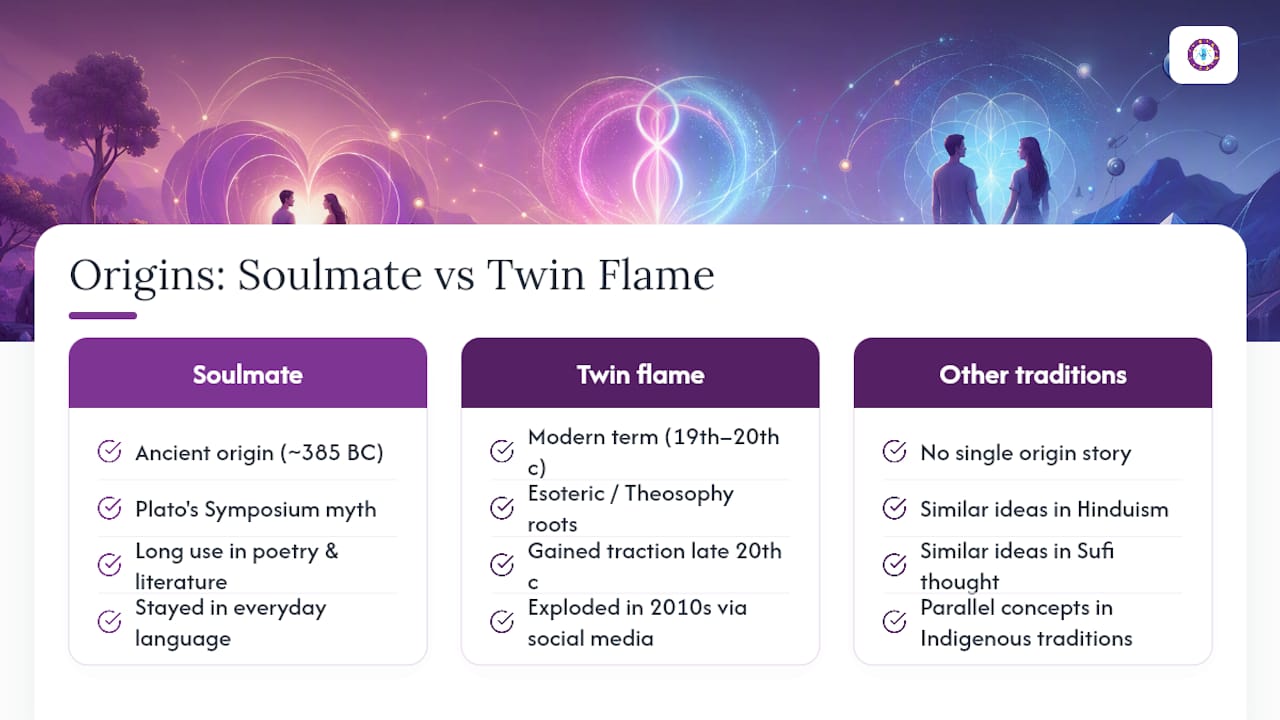
The word “soulmate” traces back to a much older idea than modern dating culture suggests. Plato’s Symposium, written around 385 BC, describes humans as originally whole beings split in two by the gods, each half then wandering the earth in search of its counterpart. That myth is essentially the ancient blueprint for both soulmates and twin flames, even though the two terms would not separate into distinct concepts for another two thousand years.
“Twin flame” as a specific phrase is far newer, emerging from 19th and 20th century esoteric and New Age movements, including Theosophy, which popularized the idea of soul fragments and soul families. The term gained real cultural traction in the late 20th century through New Age spiritual writing, then exploded into mainstream use during the 2010s alongside the broader wellness and astrology boom on social media.
“Soulmate” stayed closer to everyday romantic language throughout that history, showing up in poetry, literature, and casual conversation for centuries without the intensity baggage that twin flame carries. That’s part of why soulmate feels approachable and twin flame feels weighty. One term evolved through common usage; the other emerged from esoteric frameworks that specifically emphasize awakening, mirroring, and transformation.
Neither concept has a single agreed origin story across cultures. Similar ideas about a matched or complementary soul appear in Hindu, Sufi, and various Indigenous spiritual traditions, each with its own vocabulary and emphasis. What changed in the last fifteen years is not the underlying idea but the speed at which it spread, thanks largely to social media turning private spiritual language into public shorthand.
What Do People Get Wrong About Twin Flames and Soulmates?
The biggest myth is that a twin flame relationship is automatically your one great love. It isn’t. A twin flame is a catalyst for growth, not a guaranteed happy ending, and plenty of twin-flame connections never become romantic partnerships at all. Some stay platonic. Some end permanently at the separation stage. The mirroring is the point, not the outcome.
A second common myth: that soulmates are always romantic. Many of the deepest soulmate connections are friendships, sibling bonds, or mentorships. Limiting the term to romance erases most of what the concept was originally meant to describe.
Third, people often assume chaos and drama are proof of a twin-flame bond specifically, rather than proof of an unhealthy dynamic wearing spiritual language as a costume. Practitioners have warned that twin-flame narratives can romanticize toxic patterns, turning what should be a warning sign into something that feels fated and therefore unavoidable.
Fourth is the belief that everyone has both a soulmate and a twin flame waiting somewhere. There’s no evidence, spiritual or otherwise, that this is universal. Some people report neither. Some report several soulmates and no twin flame at all. Treating either as guaranteed puts pressure on relationships to fit a mold they were never going to fit.
Finally, many assume the runner-chaser stage means the runner is the problem and the chaser is the victim. In practice, both people usually have inner work to do, and the chaser’s pursuit can be just as much an avoidance pattern as the runner’s retreat.
How Long Do These Connections Usually Take to Unfold?
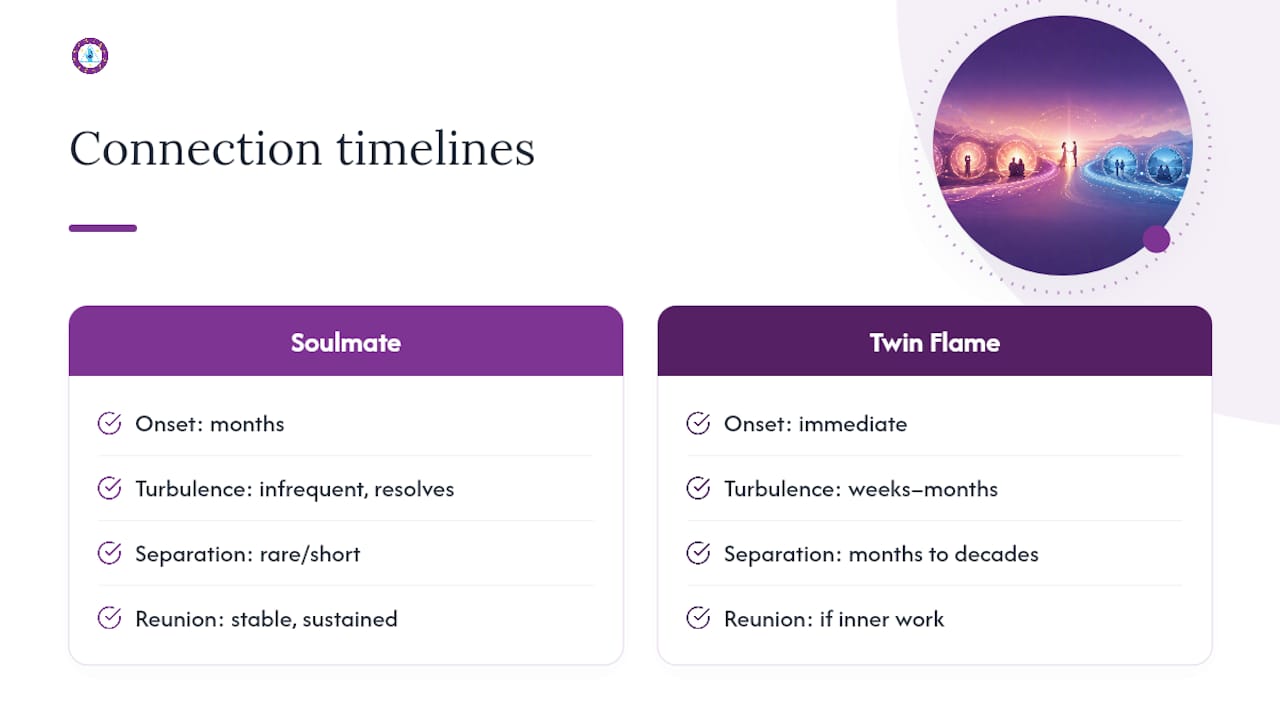
Soulmate relationships tend to follow a familiar, even reassuring arc. Initial recognition and comfort develop into deepening trust over months, then into a stable partnership or friendship that can last years or decades with relatively few dramatic swings. The progression is close to linear. Difficult stretches happen, but they resolve and the relationship moves forward rather than looping back.
Twin flame timelines look nothing like that. The recognition phase can hit within minutes of meeting someone, often described as an overwhelming, almost disorienting sense of familiarity. Turbulence tends to follow within weeks or months, as the mirroring effect surfaces both people’s unresolved issues faster than either can process them. The separation phase that comes next has no fixed length. It can last months. It can last years. Some twin-flame narratives describe separations lasting a decade or more before any attempt at reunion.
The integration or reunion phase, when and if it happens, is supposed to look different from the earlier turbulence. If both people have done genuine inner work during separation, the reunion phase tends to feel calmer and more sustainable than the original connection ever did. If neither person has changed, the reunion often just restarts the same volatile cycle, which is the clearest sign that the relationship is stuck rather than progressing.
The practical takeaway: soulmate timelines reward patience with steady payoff. Twin-flame timelines reward inner work, and without it, time alone will not resolve anything.
Why Does This Distinction Matter for Your Own Growth?
Knowing which label actually fits your relationship changes the questions you ask yourself, and that shift matters more than the label itself. If you correctly identify a connection as soulmate-style, you can focus on building, communicating, and deepening trust, because the foundation is already stable. If you correctly identify a twin-flame pattern, you can stop expecting comfort from a relationship that was never built to provide it, and instead focus on what the mirroring is actually trying to show you about yourself.
Misidentifying the two causes real harm. Treating a volatile, destabilizing connection as your soulmate keeps you waiting for a calm that may never arrive. Treating a stable, growth-oriented partner as a twin flame can make you chase drama that isn’t there, or grow bored with a connection that was actually working fine.
The clearest sign that recognizing the difference is paying off: your relationship choices start matching your actual needs instead of a borrowed narrative. That shows up in smaller decisions, like whether you keep contacting someone during a rough patch, and in bigger ones, like whether you commit to someone who feels safe rather than someone who feels fated. Clarity here is less about naming the connection correctly for its own sake and more about using that name to make better decisions going forward.
How Do Different Belief Systems View These Relationships?
New Age and metaphysical traditions treat twin flames as a single soul divided at creation, which is why the reunion (when it happens) is framed as a spiritual completion rather than an ordinary romance. Soulmates, in the same frameworks, are described as members of a broader soul family who agreed, before this lifetime, to support each other’s growth.
Hindu philosophy offers a related but distinct idea through the concept of karmic bonds and soul groups that reincarnate together across lifetimes, with certain relationships understood as carrying unfinished business from a previous life. This overlaps with, but is not identical to, the twin-flame framework, and it’s part of why “twin flames vs karmic partners” is its own common point of confusion. Karmic relationships tend to feel intense specifically because they’re resolving old patterns, while twin-flame relationships are described as activating new growth.
Christian and other monotheistic traditions generally don’t use either term, but similar themes appear in ideas about divinely appointed partnership and covenant relationships. Sufi mysticism describes a longing for spiritual union that echoes twin-flame language without using it directly.
Secular and psychological perspectives reject both frameworks as unfalsifiable, preferring attachment theory and compatibility research instead. That doesn’t make the frameworks worthless to the people who find meaning in them; it just means the language belongs to spiritual interpretation, not clinical assessment, and readers benefit from knowing which lens they’re using at any given moment.
A Final Thought on Labels and Wellbeing
Chasing the “right” label matters far less than protecting your wellbeing while you sort through an intense connection. Whether you’re navigating a soulmate compatibility reading in your own head or a genuine twin-flame pattern, stay curious about what the relationship is teaching you, but don’t let curiosity override your safety. Combine honest self-reflection with real support, whether that’s a therapist, a trusted friend, or a soulmate psychic reading that gives you outside perspective. Growth should feel like progress, not a loop.
— Jason
Ready for Clarity? Here’s How a Reading Can Help
Phonepsychicreaders exists for exactly the moment you’re in right now: staring at a confusing connection and wanting a second, experienced perspective before you make your next move. The platform states that readers undergo a vetting process intended to select experienced and reliable psychics, aiming to provide trustworthy guidance.

If you’re trying to figure out whether you’re dealing with a twin flame, a soulmate, or a karmic partner, a Twin Flame Reading or Soulmate Reading can walk through the specific patterns, timing, and likely purpose of your connection. Readers are available 24/7, billing runs per minute, and there is no long-term commitment involved. For current pricing details, please visit Phone Psychic Readers’ official website. These sessions work best alongside therapy, not instead of it, especially if anything about the relationship has felt harmful. When you’re ready to talk it through with someone experienced, book a phone psychic reading and get a live perspective on what’s really going on.
Sources
- What is a twin flame? — Medical News Today
- What Is a Twin Flame? | Vogue
- Twin Flame vs Soulmate: What’s the Real Difference? — MasterClass
- Twin Flame vs Soulmate: The Real Difference Psychics Use to Read Your Connection — Eastern Alignment
FAQ
What Are the Stages of a Twin Flame Relationship?
Most frameworks describe four broad stages: recognition, turbulence, separation, and integration or reunion. These stages are descriptive patterns practitioners observe, not a guaranteed sequence every connection must follow.
Are You Supposed to Marry Your Soulmate or Twin Flame?
Neither term requires marriage or even a romantic outcome. Soulmates can be friends, family, or partners, and twin flames often serve as catalysts for growth rather than a guaranteed life partnership.
How Do You Know If Someone Is Your Soulmate or Twin Flame?
Ask whether the connection calms and stabilizes you, which points to a soulmate, or repeatedly triggers intense growth and turbulence, which points to a twin flame. A Soulmate Reading or Twin Flame Reading can help clarify which pattern you’re actually experiencing.
Is a Twin Flame Your True Love?
Not necessarily. A twin flame is theorized as a catalytic mirror rather than a romantic guarantee, and many twin-flame connections never become lasting romantic partnerships at all.
Can Twin Flames Be Soulmates?
Yes, the two can overlap. A connection can start with intense twin-flame mirroring and later settle into the stability typical of a soulmate bond, though practitioners note the purposes usually differ even when the roles blend.