5 Questions to Tell If It's a Sign: Synchronicity vs Coincidence

Synchronicity is a meaningful coincidence, a term Carl Jung coined for events an observer feels are connected in significance even though nothing causally links them. A coincidence is simply a statistical concurrence, two things happening close together with no built-in meaning at all. The difference lives in interpretation, not in the event itself, which is why the tools below matter more than the label you choose.
Key Takeaways
- Coincidences are statistically normal events, while meaningful synchronicities involve personal significance without a causal link, making interpretation key.
- The perception of significance increases in emotionally charged, expectancy-driven, or stress-related states, often reinforced by confirmation bias.
- Synchronicity lacks scientific proof and is considered untestable, but it remains influential in therapy and cultural practices due to its psychological and philosophical appeal.
- Major decisions should not be based solely on perceived signs; journaling and weighing real evidence against emotional responses offer more balanced guidance.
- Recognizing cultural and historical frameworks shows that meaning in timing and coincidence is a universal human pattern, not exclusive to Jungian psychology.
Table of Contents
- Coincidence, Synchronicity, and Serendipity: What Each Word Actually Means
- Why Coincidences Feel Meaningful: Apophenia and Bias
- Jung, Pauli, and the Limits of the Synchronicity Idea
- How Do You Know If a Coincidence Is Actually Meaningful?
- Using Coincidences Constructively Without Overreacting
- Synchronicity Beyond Jung: How Other Cultures Have Framed Meaningful Coincidence
- Synchronicity in Literature, Film, and Everyday Pop Culture
- Does Synchronicity Prove the Universe Has a Plan? The Philosophical Debate
- Synchronicity vs Fate, Destiny, and Serendipity: Untangling Similar Ideas
- Readings as Clarification, Not Commands
- When a Coincidence Has You Second-Guessing Yourself, Talk It Through
- Sources
Coincidence, Synchronicity, and Serendipity: What Each Word Actually Means
Cambridge Dictionary defines synchronicity plainly: two or more related or similar events happening by chance at the same time. That definition overlaps almost entirely with everyday “coincidence,” which is exactly why people confuse the two.
The real split isn’t in the dictionary. It’s in who assigns meaning. Psychology Today frames synchronicity as an acausal connecting principle: two events that feel meaningfully related despite having no discoverable cause linking them. Coincidence, by contrast, is the same statistical overlap with the meaning stripped out.
Serendipity adds a third layer worth knowing. It describes a fortunate accident with a practical, outward payoff, like bumping into an old colleague who happens to be hiring. Synchronicity is internal and psychological; serendipity is external and useful. Think of coincidence as the raw event, synchronicity as the felt significance, and serendipity as the lucky break.
Why Coincidences Feel Meaningful: Apophenia and Bias
Your brain is built to find patterns, even in noise. That tendency, known as apophenia, helped early humans spot real threats and real opportunities faster than chance alone would allow. The same wiring now fires when your ex texts the moment you think of them.
Apophenia isn’t a flaw. SELF reports it’s linked to creativity and higher life satisfaction in many people, though it can also correlate with riskier, conspiratorial belief patterns when it runs unchecked. Context and self-awareness make the difference.
Who notices coincidences most? People in emotionally charged states, sadness, anxiety, anger, along with those who score high on meaning-seeking personality traits, are more likely to spot and report them as significant, according to Psychology Today. Psychologist Colin DeYoung’s work on meaning-making traits echoes this pattern: the drive to find significance is a stable part of personality, not a random glitch. Confirmation bias does the rest, quietly filtering out the hundred near-misses that never lined up so you only remember the one that did.
Jung, Pauli, and the Limits of the Synchronicity Idea
Jung built synchronicity around a single striking session with a patient. She described a dream about a golden scarab beetle; moments later, a real scarab beetle tapped against his office window. He couldn’t explain the timing through cause and effect, so he proposed something else: an acausal connecting principle, meaning tied to timing rather than to mechanism.
He didn’t develop the idea alone. Jung collaborated with physicist Wolfgang Pauli, hoping to root synchronicity in something closer to physics than folklore, which is partly why the concept still carries philosophical weight decades later, according to Wikipedia’s entry on synchronicity.
Mainstream science remains unconvinced, and for a specific reason: synchronicity isn’t falsifiable. There’s no test that could disprove it, which puts it outside the boundaries of empirical science even where it remains influential in psychotherapy. Most statisticians would rather point to the sheer number of daily coincidences that probability alone predicts. Both things can be true: the concept holds clinical value, and it holds no scientific proof.
How Do You Know If a Coincidence Is Actually Meaningful?
Run the event through a short mental checklist before you decide it’s a sign worth acting on.
- Specificity: Is the overlap oddly precise, or could it describe thousands of ordinary days?
- Rarity: Has this exact pattern happened once, or does it happen often enough that you’re only now noticing it?
- Emotional intensity: Did it hit you hard because it’s genuinely unusual, or because you’re already stressed and primed to search for meaning?
- Prior expectation: Were you already hoping for this exact outcome, which makes confirmation bias more likely?
- Actionable alignment: Does the insight point toward something you can actually verify or act on, or just toward a feeling?
Watch for red flags too: pressure to make a fast decision, a “sign” that conflicts with your own values, or isolating yourself from people who’d offer a second opinion. Those patterns suggest the meaning is being manufactured under stress, not discovered.
Pro Tip: Before deciding an event is meaningful, jot it down along with what else was going on that day. A pattern that repeats across several separate entries carries more weight than one striking moment you remember because it felt dramatic.
Using Coincidences Constructively Without Overreacting
Treat a coincidence as a prompt, not an instruction. A simple journaling routine works well: write down the event, your immediate feeling, what might have triggered it, and any action you’re now considering. That short exercise turns a fuzzy, emotional moment into something you can actually examine later with a clearer head, according to Psychology Today.
A useful rule of thumb: never make a major life decision on a perceived sign alone. Weigh it against real evidence, your values, and input from people you trust. If a coincidence nudges you to reconsider a relationship or a job, let that nudge start a conversation or some research, not an immediate leap.
One caution deserves its own sentence. If interpreting signs starts overriding evidence constantly, or if it’s isolating you from friends and family who question the pattern, that’s worth raising with a mental health professional, since it can sometimes correlate with more extreme belief patterns, per SELF.
Synchronicity Beyond Jung: How Other Cultures Have Framed Meaningful Coincidence
Jung didn’t invent the underlying idea that timing can carry meaning. He gave it a clinical name. Long before analytical psychology existed, cultures across the world built entire frameworks around the notion that events line up for a reason.
Chinese philosophy offers one of the oldest parallels through the I Ching, where the timing of a divination is treated as inseparable from its meaning, an idea Jung himself studied closely and cited as an influence on his own thinking. Indigenous traditions in many regions treat unusual animal encounters or natural signs as communication rather than accident, embedding meaning-making into daily spiritual practice rather than treating it as an occasional curiosity.
Caribbean literary and cultural traditions offer a useful modern parallel too. Ritual practices there are often framed not as superstition but as a legitimate form of knowledge passed through generations, a distinction explored in depth in analysis of ritual in Caribbean literature. That reframing matters: what one culture dismisses as coincidence, another treats as an established, coherent system for reading the world.
Western esoteric traditions, from astrology to numerology, run on a similar logic: pattern and timing as data, not noise. None of these systems prove causation any more than Jung’s scarab beetle did. What they share is a consistent human instinct to organize meaningful timing into a framework, rather than letting it dissolve into isolated, unexplained moments.
Synchronicity in Literature, Film, and Everyday Pop Culture
Storytellers have leaned on synchronicity for centuries because it does something plot mechanics can’t: it makes coincidence feel like fate without ever confirming it. Charles Dickens built entire novels, “Great Expectations” among them, around characters whose paths cross improbably at exactly the right moment, a structural choice that keeps readers hunting for hidden connections until the final chapter.
Modern film uses the same device constantly. Movies built around interconnected strangers whose lives brush against each other in small, unexplained ways rely on the audience’s own apophenia to feel the weight of the pattern, even when no character in the story could ever prove a cause.
Musicians and visual artists reach for the same language. Songs and album titles referencing “signs” or “synchronicity” (The Police even named a 1983 album after the concept directly) tap into a shared cultural shorthand: audiences already know what the word implies before the artist explains anything.
Social media has only accelerated this. A viral post about someone seeing the same number sequence for weeks, or hearing a song at the exact moment they needed to hear it, spreads faster than almost any other kind of personal story, precisely because so many people recognize the feeling. The pattern-recognition instinct that Jung tried to formalize clinically is the same one keeping those posts in your feed.
Does Synchronicity Prove the Universe Has a Plan? The Philosophical Debate
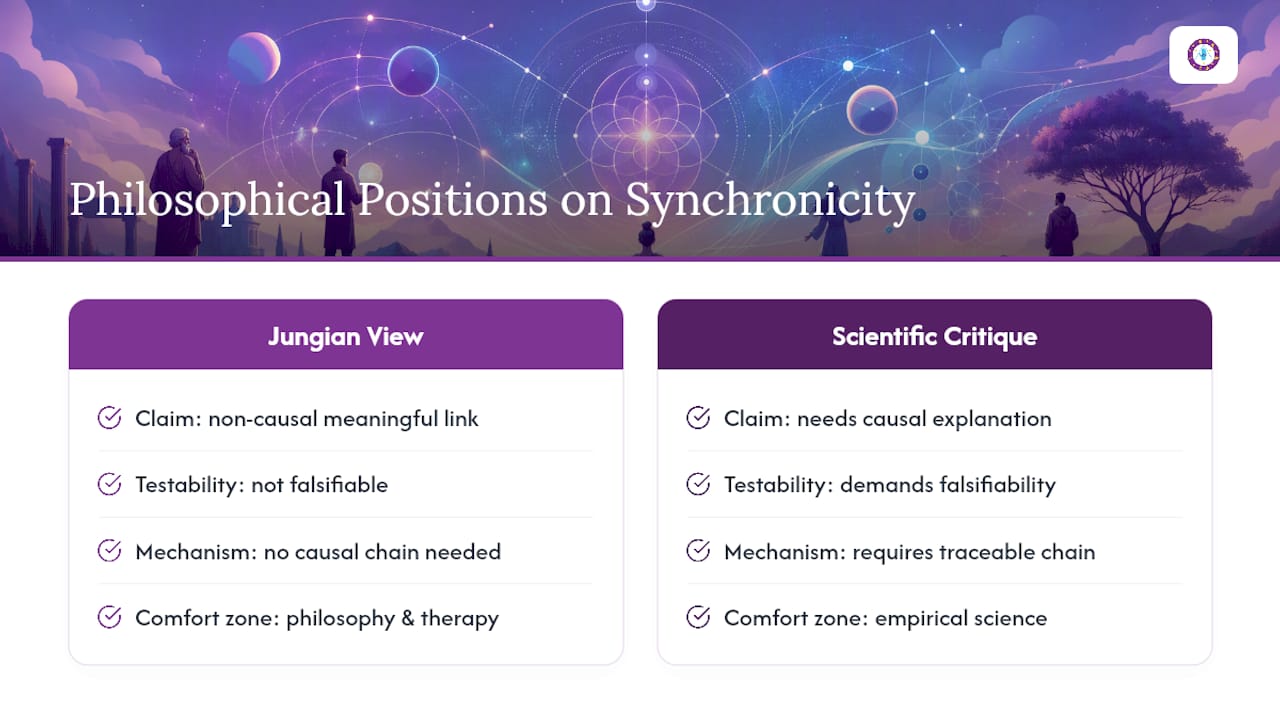
Here’s the real philosophical fault line: does a meaningful coincidence reveal something true about how reality is organized, or does it only reveal something true about how your mind organizes information? Jung’s own answer leaned toward the former. He wanted synchronicity to describe an actual, if non-causal, connection between inner psychological states and outer events.
Critics push back hard on that claim, and their objection isn’t dismissive, it’s structural: a theory that can’t be tested or falsified can’t be evaluated as science, no matter how compelling the individual experience feels. Some researchers and philosophers argue the evidence leaves room for organizing principles beyond pure chance, while acknowledging that view remains genuinely contested rather than settled.
The causality question sits underneath all of it. Traditional science demands a mechanism: A causes B through some traceable chain. Synchronicity asks you to accept meaning without mechanism, correlation elevated to significance without a causal bridge connecting the two events. That’s a genuinely uncomfortable idea for anyone trained in linear cause and effect, and it’s precisely why the concept sits more comfortably in philosophy and psychotherapy than in a peer-reviewed physics journal.
None of that makes the felt experience less real. It just means the honest answer to “did the universe arrange this” is: nobody can prove it either way, and the more interesting question is usually what you do with the feeling.
Synchronicity vs Fate, Destiny, and Serendipity: Untangling Similar Ideas
These four words get used interchangeably, but they aren’t describing the same thing, and mixing them up leads to muddled thinking about what to actually do with an experience.
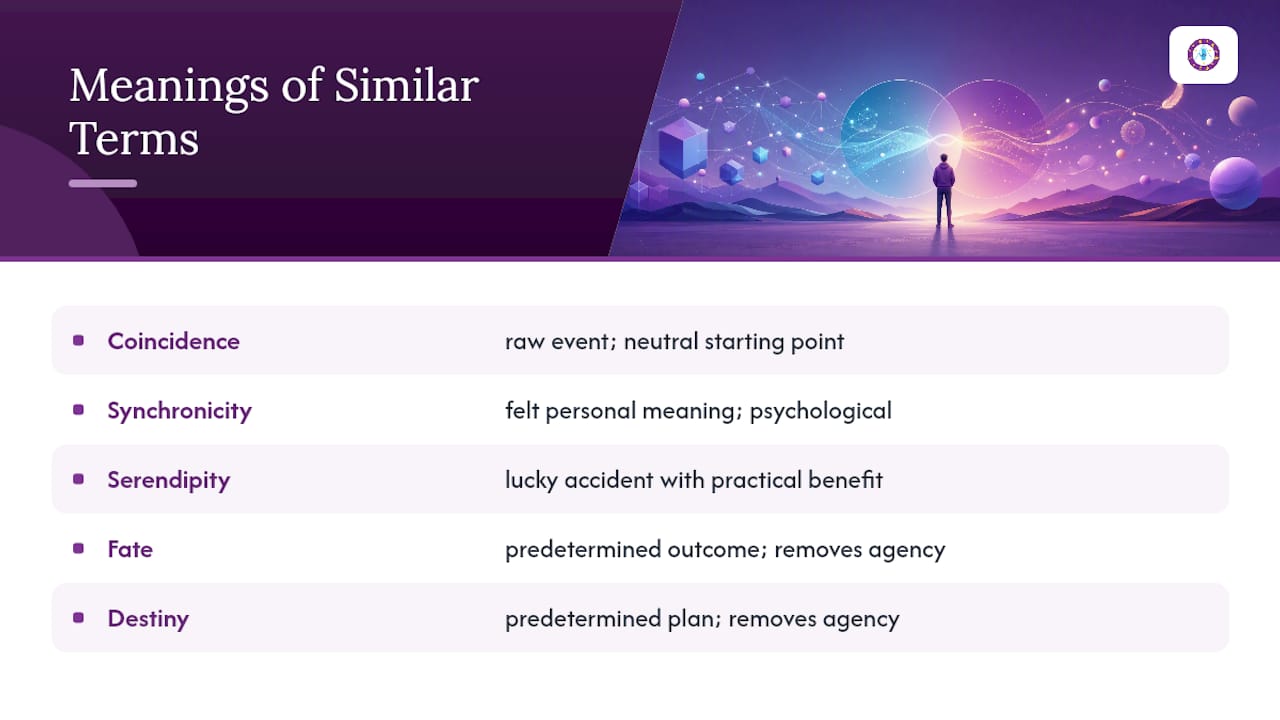
Fate and destiny imply a predetermined outcome, a plan that exists whether you notice it or not. They carry the heaviest philosophical weight because they remove your agency from the equation entirely; something was always going to happen regardless of your choices.
Synchronicity makes a smaller, more personal claim. It says this particular moment felt meaningfully connected to your inner state, without asserting anything about a grand plan for your life. You can believe in synchronicity without believing in fate at all.
Serendipity is the most grounded of the four. It’s not about hidden meaning, it’s about a lucky accident that produces a concrete, external benefit, distinguishing it from synchronicity’s internal, psychological character, as Psychology Today points out.
Coincidence sits underneath all three as the raw material. Every synchronicity, every stroke of serendipity, and every “fated” encounter starts as a plain coincidence before a person decides how much meaning to layer on top of it.
Knowing which word actually applies to your situation changes what you should do next. A destiny framing invites passivity, waiting for the plan to unfold. A synchronicity framing invites reflection. A serendipity framing invites action, since there’s a real opportunity sitting in front of you.
Readings as Clarification, Not Commands
A phone reading works best as a mirror, not a mandate. When you bring us a coincidence you can’t shake, a strange dream, a name that keeps resurfacing, a good reader doesn’t hand you an order. They help translate a fuzzy feeling into sharper questions: what are you actually hoping this means, and what would you do differently if it turned out to mean nothing at all?
Phonepsychicreaders hand-vets every reader who joins the platform, and only a small share of applicants make it through, which keeps the guidance grounded rather than theatrical. Readers are available 24/7, so you’re never stuck sitting with an unsettling coincidence until Monday morning. People consistently tell us they leave sessions feeling grounded, not because a reader made their decision for them, but because the conversation clarified what they already sensed. A reading should widen your options, never narrow your agency.
— Jason
When a Coincidence Has You Second-Guessing Yourself, Talk It Through
Some coincidences just need a second, calmer perspective, not a verdict. Phonepsychicreaders connects you with hand-vetted readers 24/7, so when something odd happens at 2 a.m. and you can’t stop turning it over, you don’t have to wait for daylight or a therapy slot three weeks out.
A short call typically starts with clarifying questions about what actually happened and how it made you feel, then moves into a reflective read on what the timing might mean for your situation, whether that’s a relationship, a career move, or something harder to name. Sessions run per minute, and first-time callers get an introductory rate, so you can test whether a reading actually helps before committing to anything longer. If you’re weighing something bigger than a single strange moment, our guide on choosing the right reading for major life decisions walks through how to pick a format that fits. Ready to talk it through? Browse available psychic readings and connect with a reader now.
Sources
- Synchronicity | Psychology Today
- Feel like the universe is sending you signs? Blame apophenia | SELF
- Synchronicity — Wikipedia