
5 Step Synastry Reading Workflow You Can Use Without Birth Times
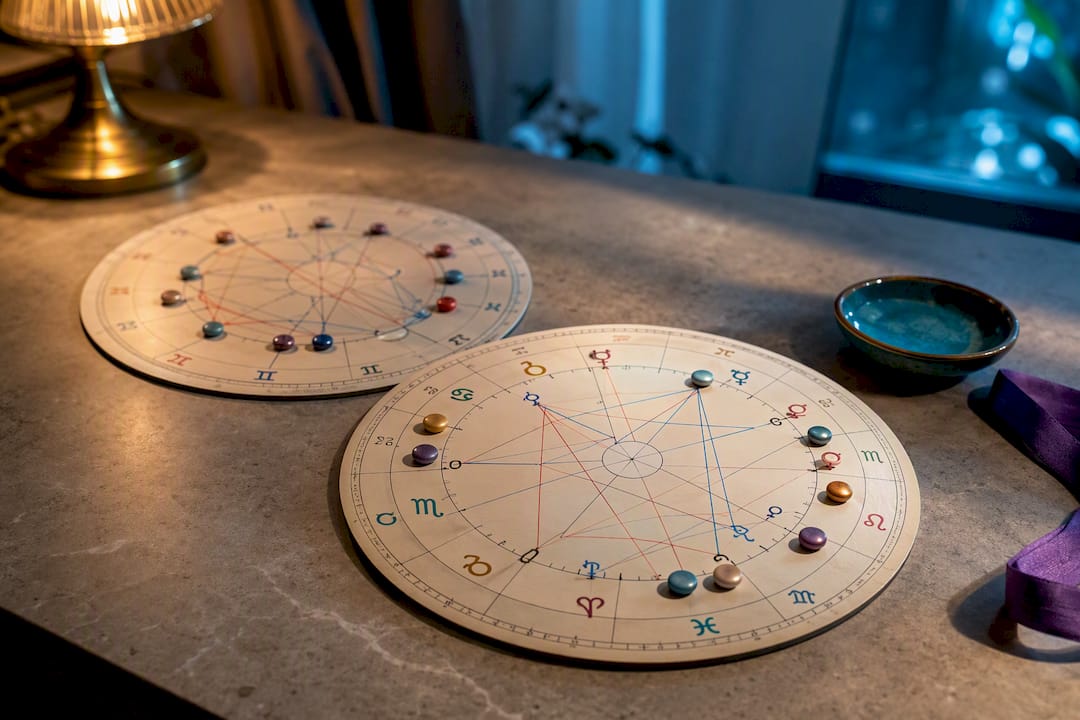
A synastry reading overlays two people’s birth charts to show where their planets connect, clash, and quietly support one another. You get a bi-wheel chart, a list of aspects between planets, house overlays showing which life areas get activated, and a plain-language read on chemistry, friction, and long-term potential. You need each person’s birth date, place, and ideally birth time, though a solid reading is still possible without exact times.
Key Takeaways
- Synastry compares both full natal charts to reveal how planets contact, clash, and support each other, providing insights into chemistry and long-term potential.
- Accurate house overlays depend on precise birth times, but significant planet-to-planet aspects remain reliable even with approximate or unknown times.
- Tighter, under 3-degree orbs, especially between personal planets like Sun, Moon, Venus, and Mars, carry more interpretive weight than wider orbs or numerous minor aspects.
- Soft aspects like trines and sextiles typically indicate easy flow, while squares and oppositions suggest productive tension or friction, with context determining their significance.
- Seeing multiple related aspects and a focus on key planets generally provides a clearer, more useful picture than overloading on many loose or wide contacts.
Table of Contents
- What Is a Synastry Reading, and How Is It Different From a Composite Chart?
- Practitioner Step-by-Step Reading Order to Follow When You Have Two Charts
- How Do You Interpret the Key Synastry Aspects?
- House Overlays, Birth Times, and What to Do Without Them
- How to Get a Free Synastry Chart and Read the Output
- A Worked Example and a Portable Synastry Checklist
- When to DIY and When to Call a Live Reader
- Get a Live Synastry Reading When You Want More Than a Chart Printout
- Where to Learn More About Synastry
- Sources
- FAQ
What Is a Synastry Reading, and How Is It Different From a Composite Chart?
Synastry is the branch of astrology that compares two full natal charts to see how they interact, planet by planet, house by house. The technique dates back centuries and shows up across both Western and Vedic astrology, though the mechanics differ between traditions. In plain terms, you take Person A’s chart and Person B’s chart, layer one on top of the other, and measure the angles (called aspects) between every planet in one chart and every planet in the other. Merriam-Webster’s own definition puts it simply: synastry is the concurrence of starry position or influence upon two people, which is a tidy way to say two skies, read together.
That overlay does two things at once. First, it maps the aspects: is your Venus sitting in an easy trine to their Moon, or a tense square to their Saturn? Second, it maps house overlays, meaning where each person’s planets fall inside the other’s house wheel. If your partner’s Mars lands in your seventh house (the house of partnership), that’s a different signal than the same Mars landing in your second house (money and resources). Synastry captures both layers, which is why it reads richer than a quick sun-sign compatibility check that only compares two zodiac signs and ignores everything else in the chart.
People often confuse synastry with a composite chart, and the distinction matters. A composite chart takes the midpoints between two charts and builds a brand new, third chart, one that represents the relationship itself as its own entity, almost like the relationship has a personality of its own. Synastry, by contrast, never merges anything. It keeps both charts intact and simply measures how they talk to each other. Think of synastry as a conversation between two people and a composite as a description of the “third thing” the two of them create together. Some practitioners use a Davison chart instead of a composite, which calculates a real midpoint in time and space rather than a mathematical average, but the underlying purpose is the same: describing the relationship as its own unit, not the individual dynamic between two people.
Synastry isn’t reserved for romance. Friends run it to understand why one relationship feels effortless and another feels like constant negotiation. Business partners use it to flag where communication (Mercury) or authority (Saturn) might create friction before they sign anything. The technique flexes to whatever kind of connection you’re trying to understand.
Practitioner Step-by-Step Reading Order to Follow When You Have Two Charts
Reading a synastry chart in a random order is how people end up overwhelmed by forty aspect lines and no sense of what actually matters. Working astrologers tend to follow a consistent five-step sequence that starts broad and narrows toward specifics. Here’s how to walk through it yourself.
- Confirm who is who on the bi-wheel. Most chart software puts one person’s planets on the inner ring and the other’s on the outer ring. Label them by name before you interpret a single aspect. Reading someone else’s Mars as your own is the single most common beginner mistake, and it corrupts every conclusion that follows.
- Read the luminaries and angles first. Start with the Sun, Moon, and the Ascendant/Descendant axis in both charts. These are the “spine” of the reading, the deep-recognition layer that tells you whether two people fundamentally see each other clearly. A practitioner-recommended framework treats this step as non-negotiable before moving to anything else.
- Move to inner-planet chemistry. Venus and Mars tell you about attraction, desire, and what each person finds appealing. Mercury tells you how the two of you actually talk, argue, and process information day to day. This is where “chemistry” as most people mean it actually lives.
- Sort every aspect by orb, then bring in Saturn and the outer planets. An orb is simply how many degrees apart two planets sit from an exact aspect. Tighter orbs (closer to 0°) carry more weight than loose ones. Once you’ve ranked your tightest contacts, layer in Saturn (commitment and structure) and the outer planets (Uranus, Neptune, Pluto) for depth and long-term transformation themes.
- Check house overlays and angles, then confirm with a composite or Davison chart. House placements tell you which parts of life get activated, career, home, money, communication, and the composite or Davison chart gives you a final gut check on the relationship as its own unit rather than two individuals colliding.
This order isn’t arbitrary. Practitioners lead with luminaries and angles because they set the interpretive frame everything else sits inside; chemistry indicators read differently depending on whether the Sun/Moon foundation is warm or strained, and outer-planet contacts add depth rather than driving the headline of the reading.
Pro Tip: Don’t count aspects. A chart with fifteen minor, wide-orb aspects and no tight ones is far weaker than a chart with three tight, exact contacts between the Sun, Moon, and Venus. Weight beats volume every time.
Working through this sequence by hand, or even with fast software pulling the raw data, generally takes a practiced astrologer 45 to 90 minutes for a live reading, including 15 to 20 minutes of prep. If you’re new to this, expect your first few charts to take longer since you’ll be cross-referencing aspect meanings as you go. That’s normal, and it gets faster with repetition.
How Do You Interpret the Key Synastry Aspects?
The five aspect types you’ll see repeatedly are conjunctions (0°, same-place energy), oppositions (180°, magnetic but polarized), squares (90°, productive tension), trines (120°, effortless flow), and sextiles (60°, easy cooperation with some effort). None of these are automatically “good” or “bad.” A square between two Suns can create real growth through friction, while a trine between two Saturns can occasionally mean mutual avoidance of hard conversations, since nothing forces the issue.
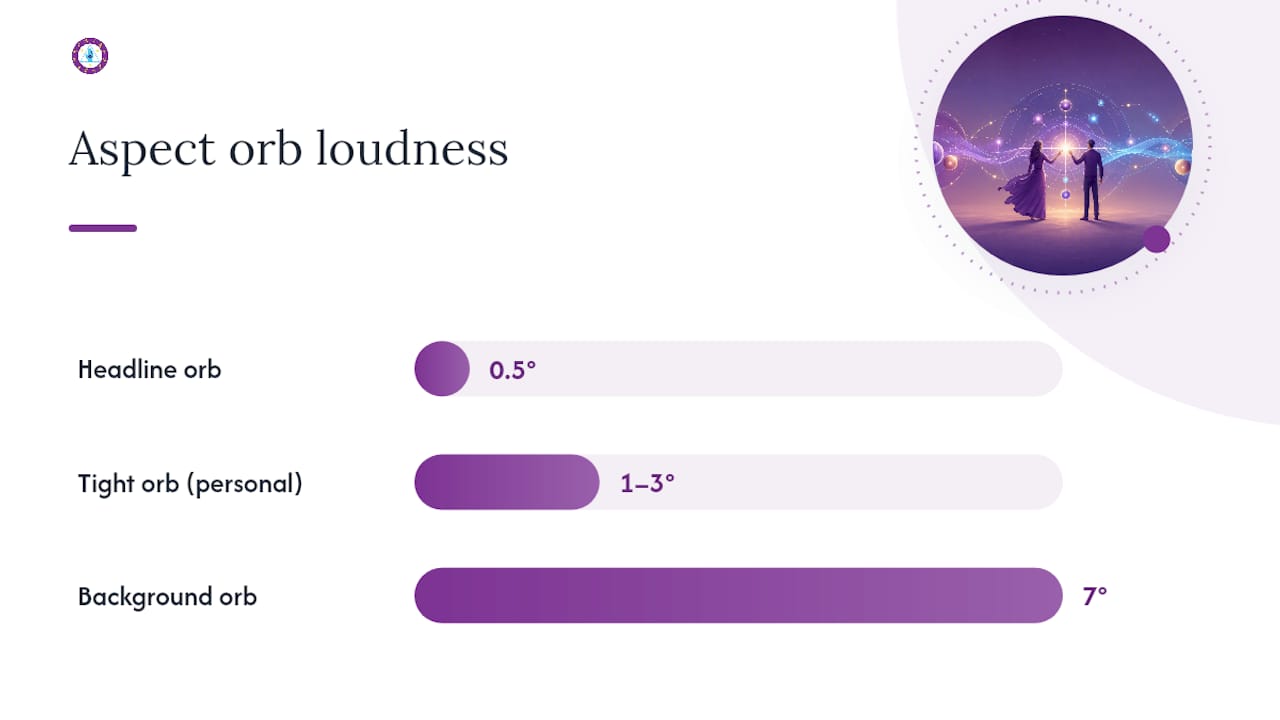
Orbs decide how loud an aspect is. As a working rule, personal planets deserve a tight orb, often 1 to 3 degrees, to count as meaningful. A Venus-Mars conjunction at 0.5° is a headline. The same conjunction at 7° is background noise you can mostly set aside.
What each core pairing tends to signal:
- Sun-Moon and Moon-Moon contacts point to recognition and emotional fluency, whether you feel instinctively “read” by the other person or have to work to explain yourself.
- Venus-Mars and Venus-Venus contacts shape attraction and shared values, covering both the spark and whether you actually want the same things out of life.
- Mercury contacts determine whether conversation flows or requires translation, especially under stress.
- Saturn contacts signal commitment, responsibility, and staying power, though a hard Saturn aspect is not a warning sign by itself. It often means the relationship asks for real effort and follow-through rather than offering easy comfort.
- Uranus, Neptune, and Pluto contacts add intensity, idealization, or transformation themes, but they shouldn’t dominate a reading on their own.
That last point deserves emphasis. A single tight Pluto-Venus conjunction can feel dramatic on paper, obsessive intensity, magnetic pull, but one contact rarely tells the whole story. The more reliable signal is a repeating theme: several related contacts pointing the same direction. One widely used beginner rule from practitioners is to weight repetition over any single “perfect” aspect, because a chart that shows Venus-Mars, Venus-Sun, and Mars-Moon contacts all pulling toward attraction tells you far more than one isolated trine ever could.
Saturn deserves a specific note, because it’s the aspect most likely to spook a first-time reader. A tight Saturn-Sun or Saturn-Moon square doesn’t mean the relationship is doomed. It usually means the connection asks for patience, consistency, and less spontaneity than either person might want, which is a very different message than “avoid this person.”
House Overlays, Birth Times, and What to Do Without Them
House overlays tell you which area of life gets activated when two charts meet, and they can shift the entire tone of a reading. A partner’s Sun landing in your seventh house often points to a partnership-focused dynamic, front and center from the start. Venus falling in someone’s fourth house tends to bring a domestic, homebody warmth to the connection. Mars in the tenth house can signal a relationship that fuels ambition and career visibility, sometimes in a competitive way. Saturn landing in someone’s second house often brings a practical, resource-focused seriousness, money conversations happening earlier than either person expected.
Here’s the catch: house overlays and anything tied to the angles (Ascendant, Midheaven, and the house cusps) require an accurate birth time. Move someone’s birth time by even twenty minutes and their entire house wheel can shift enough to change which house a planet lands in.
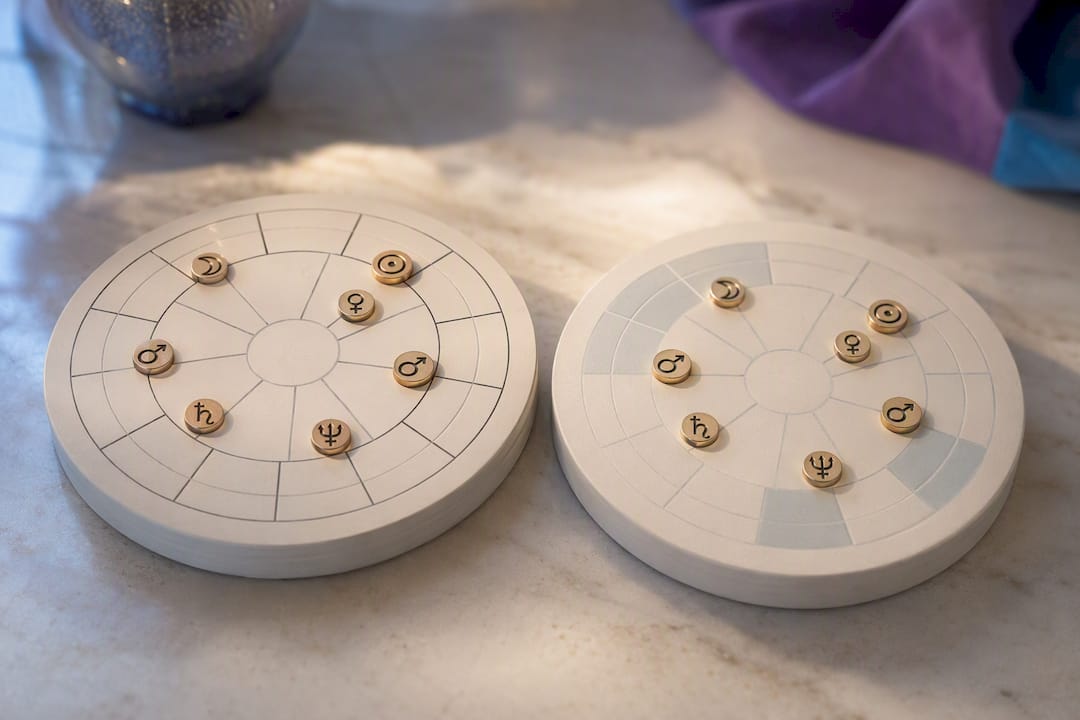
The good news is that planet-to-planet aspects don’t share that sensitivity. A Venus-Mars trine is a Venus-Mars trine whether someone was born at 2:00 AM or 2:40 AM, because it’s based on planetary positions relative to each other, not relative to the horizon. That means a meaningful reading is still possible with an approximate or even unknown birth time.
If you or your partner doesn’t have an exact time, here’s how to adapt:
- Read all planet-to-planet aspects first (Sun, Moon, Venus, Mars, Mercury, Saturn, outers). This layer stays fully reliable regardless of time.
- Skip or heavily caveat any house overlay interpretation until you have a confirmed time.
- Ask family members or check a birth certificate. Many people underestimate how often this information is actually recoverable.
- Consider a noon chart as a rough placeholder for angles only, understanding that this is an approximation, not a substitute for rectification.
- Treat professional birth-time rectification (working backward from major life events) as a last resort, since it’s time-intensive and imprecise for casual use.
Pro Tip: If you’re stuck without a birth time, lead with the Moon-Moon and Venus-Mars aspects. They carry real emotional and attraction weight and don’t depend on the angles at all, so you’re not stuck waiting on a detail you may never recover.
How to Get a Free Synastry Chart and Read the Output
Generating a synastry chart yourself takes about five minutes once you have the right inputs. Most free calculators ask for the same four data points for each person: full birth date, birth time (or “unknown” if that’s genuinely the case), birth place (city and country, since the tool needs coordinates and time zone), and sometimes the exact time zone if the city isn’t recognized automatically.
What to enter and how to check it:
- Enter both people’s birth dates exactly as they appear on official records.
- Enter birth place as a city, not a region, since coordinates change the calculation even within the same state or province.
- Enter birth time in 24-hour format if the tool asks for it, to avoid AM/PM mix-ups that quietly flip a chart by twelve hours.
- Double-check the calculated Ascendant against what you already know about yourself, since a wildly unfamiliar rising sign description is often a sign the time or time zone was entered wrong.
Once generated, most free tools return three things: a bi-wheel chart image with both people’s planets on it, an aspect grid (a table showing every meaningful angle between the two charts), and house overlay positions. Some also throw in a short written interpretation, which is a nice starting point but shouldn’t be treated as the final word.
Not every calculator is built the same way, and the differences matter more than most people assume. Before trusting a tool’s narrative, check three things: what orb it uses by default (tighter orbs give more conservative, arguably more accurate results), whether it includes house overlays and angles at all (some strip these out entirely if birth time is missing), and whether it offers a composite or Davison chart alongside the synastry overlay. Free reports vary widely on all three points, so comparing two tools’ output for the same couple can produce noticeably different emphasis.
Watch for a few red flags. Any tool that hands you a flat “you’re compatible” or “you’re not compatible” verdict without showing its aspect list is skipping the actual analysis. Same with a tool that never discloses its orb settings, since that’s the number that determines whether an aspect even counts. And be skeptical of any interpretation that makes definitive predictions about the relationship’s future rather than describing tendencies and dynamics.
A Worked Example and a Portable Synastry Checklist
Here’s a short, anonymized walk-through using the reading order above. Two people, call them A and B, generate a synastry chart. A’s Sun trines B’s Moon (tight orb, under 2°), suggesting mutual recognition and warmth right out of the gate. A’s Venus squares B’s Mars (orb of 3°), which reads as strong physical attraction laced with occasional friction over pacing. A’s Mercury sextiles B’s Mercury, a good sign for conversation flowing easily. B’s Saturn conjuncts A’s Sun, meaning B brings a stabilizing, sometimes serious weight to the relationship, worth naming so neither person mistakes it for coldness. Finally, A’s Venus falls in B’s seventh house, reinforcing the partnership-oriented theme already showing up in the Sun-Moon trine.
Put together, the reading synthesizes into a clear headline: warm recognition, real attraction with some pacing friction, easy communication, and a partner who adds structure rather than distance. That’s a usable, honest read, not a verdict of “great match” or “bad match.”
Checklist to run on any chart you generate:
| Step | What to check |
|---|---|
| Luminary headline | Sun-Moon and Moon-Moon aspects between both charts |
| Attraction signature | Venus-Mars and Venus-Venus contacts, noted by orb |
| Communication note | Mercury-Mercury and Mercury-Venus/Mars aspects |
| Structural weight | Saturn contacts to personal planets, read without alarm |
| Life-area overlays | Where key planets fall in the other person’s houses |
| Repeating themes | Aspects pointing in the same direction across multiple planets |
| Next step | Composite or Davison chart, or a live reading for nuance |
Three mistakes trip up most beginners. First, treating every aspect as equally important instead of sorting by orb, which buries the real signal under noise. Second, panicking at a single hard Saturn or Pluto contact instead of reading it in context with everything else. Third, skipping the house overlay step entirely just because birth time feels optional, when it’s only optional for the angles, not for the rest of the chart.
When to DIY and When to Call a Live Reader
A self-generated synastry chart works well for a first pass, satisfying curiosity, or understanding a friendship dynamic where the stakes are low. Where it starts to fall short is when you’re facing a real decision: should you move for this relationship, is a recurring conflict pattern actually a Saturn theme or something else entirely, or how a specific upcoming transit might affect timing for a big step like moving in together or ending things.
That’s where a live reading earns its keep. A vetted astrologer can ask you clarifying questions your chart can’t answer on its own, prioritize which of your ten aspects actually matters for the question you’re asking, and layer in current transits that a static synastry chart doesn’t show. It’s the difference between reading a map and talking to someone who’s walked the terrain.
If you’ve run your own chart and still feel unsettled about what it means for your specific situation, that’s a reasonable moment to bring in a second, trained set of eyes rather than second-guessing yourself in circles.
— Jason
Get a Live Synastry Reading When You Want More Than a Chart Printout
A free calculator gives you the raw aspects. What it can’t do is sit with your specific question, weigh which contacts matter most for your situation, and tell you what’s coming next astrologically. Phonepsychicreaders fills that gap with live astrology compatibility readings by phone, staffed by hand-vetted readers available 24/7, so you’re not stuck interpreting a Saturn square alone at midnight.
A phone reading works best as a follow-up to the DIY work you’ve already done. Bring your chart’s headline findings, the tight aspects, the repeating themes, and use the call to clarify what’s ambiguous and get timing guidance for transits your calculator can’t read. If romance is the specific focus, the love astrology reading line goes deeper on relationship-specific patterns. Ready to talk it through? Explore current readings and connect with a vetted reader now.
Where to Learn More About Synastry
- Synastry — Wikipedia: a solid overview of the technique’s history and its use across astrological traditions.
- SYNASTRY Definition & Meaning - Merriam-Webster: the dictionary-level definition for anyone who wants the term in its simplest form.
- How to Read a Synastry Chart: Step-by-Step Guide + Example — SynastryCalc: a practitioner walkthrough of reading order and orb weighting.
- How to read a synastry chart: practitioner reading order — Astrolium: detailed guidance on sequencing and orb standards used by working astrologers.
- How to Read a Synastry Chart: Step-by-Step - Learn Astrology — Kerykeion: practical notes on what’s possible without an exact birth time.
Sources
- Synastry — Wikipedia
- SYNASTRY Definition & Meaning - Merriam-Webster
- How to Read a Synastry Chart: Step-by-Step Guide + Example — SynastryCalc
- How to read a synastry chart: practitioner reading order — Astrolium
- How to Read a Synastry Chart: Step-by-Step - Learn Astrology — Kerykeion
FAQ
What Is a Synastry Reading?
A synastry reading overlays two people’s birth charts to compare planet positions and measure the aspects between them, showing where two people naturally align and where friction is likely. It draws on the same technique astrologers have used for centuries to study relationship compatibility, romantic or otherwise.
What Are the Worst Synastry Aspects?
No aspect is universally “bad,” but tight squares and oppositions involving Saturn, Mars, or Pluto tend to bring the most friction, often around control, pace, or intensity. Context matters more than the label. A hard Saturn aspect often signals a relationship that demands real effort rather than one that’s doomed.
Where Can I Get a Free Synastry Analysis?
Several free online calculators generate a synastry chart once you enter both people’s birth date, time, and place, returning a bi-wheel chart, an aspect grid, and house overlays. Compare a couple of tools before trusting one narrative, since orb settings and included features vary from calculator to calculator. If you want a live interpretation of what your chart actually means, Phonepsychicreaders offers astrology compatibility readings by phone.
What Is the Strongest Synastry Aspect?
Tight conjunctions and trines between the Sun, Moon, and Venus tend to carry the most weight, especially when several related aspects repeat the same theme across both charts. A single wide-orb aspect rarely matters as much as a cluster of tight contacts pointing the same direction.
Do I Need Exact Birth Times for a Synastry Reading?
Exact times matter for house overlays and the angles (Ascendant, Midheaven, house cusps), but most planet-to-planet aspects read accurately without them. If a birth time is missing, start with Sun, Moon, Venus, and Mars aspects, which hold up regardless.