
Two Anchors to Read Your Year: Solar Return Reading Workflow

A solar return reading is a chart cast for the exact moment the Sun returns to the same degree it occupied when you were born, and it maps the central theme, emotional climate, and timing of your next birthday year. The two anchors to check first are your solar return Ascendant, which sets the tone, and the Sun’s house placement, which names the main arena of focus. From there, get your chart cast precisely and read it alongside your natal chart for real clarity.
Key Takeaways
- The solar return chart activates specific themes and emotional focuses based on the Ascendant sign and the Sun’s house placement, which can shift yearly.
- The Moon’s house and sign reveal emotional timing, with its movement roughly one house per month indicating when key themes will peak.
- Angular planets and conjunctions, especially near the Ascendant or Midheaven, significantly influence the year’s main areas of focus, such as self-presentation or career.
- Accurate interpretation requires overlaying the solar return chart with your natal chart, considering house placements, planetary aspects, and your exact birth time and location.
- Professional readings offer nuanced insights, with the best results from integrating solar return themes with natal patterns and timing techniques like profections.
Table of Contents
- What Is a Solar Return Chart, and How Is It Different From Your Natal Chart?
- How Do I Read My Solar Return Chart? Start With the Ascendant and Sun’s House
- What Does the Solar Return Moon Tell You About Timing?
- Which Planets Matter Most in a Solar Return Chart?
- How Do You Overlay a Solar Return on Your Natal Chart?
- Why Does Birth Time and Location Matter for a Solar Return Chart?
- What Should You Expect From a Professional Solar Return Reading?
- How Do You Use a Solar Return Reading Once You Have One?
- What Makes Solar Return Charts Hard to Interpret?
- What Do Solar Return Themes Look Like in Practice?
- An Editorial Note on Reading Your Solar Return Responsibly
- Get a Personalized Solar Return Reading by Phone
- Where to Cast and Study Your Solar Return Chart
- Sources
- FAQ
What Is a Solar Return Chart, and How Is It Different From Your Natal Chart?
Your natal chart is cast for the moment you were born and never changes. A solar return chart is recalculated every single year, cast for the exact minute the transiting Sun lines back up with your natal Sun’s degree. That moment might land a few hours earlier or later each year, and it can even shift the actual calendar date by a day.
Think of the solar return as a seasonal weather report laid over your permanent climate. The natal chart tells you who you are at your core. The solar return tells you what conditions to expect between this birthday and the next one. It governs a strict twelve-month window, birthday to birthday, and it never overrides your natal blueprint. Instead, it colors how that blueprint gets activated for one specific year, which is why the two charts work best read together rather than in isolation.
How Do I Read My Solar Return Chart? Start With the Ascendant and Sun’s House
This is the step readers ask about most, and for good reason: your solar return Ascendant and Sun placement do most of the interpretive heavy lifting. Professional astrologers typically anchor a solar return reading on three primary features: the Ascendant, the Sun’s house, and angular planets. Start with the first two.
- Note the sign on your solar return Ascendant. A Scorpio rising year feels intense and private. A Gemini rising year feels social, mentally busy, and scattered in a good way.
- Identify the ruler of that Ascendant sign, then find where that ruling planet sits in the chart. It often points to a secondary area getting pulled into the year’s story.
- Locate the Sun’s house. The Sun in the 10th house often means career visibility takes center stage. The Sun in the 7th tends to spotlight partnerships and negotiations. The Sun in the 4th often turns attention toward home, family, or a literal move.
- Combine the two into one sentence. For example: “This is a Capricorn rising year (disciplined, structure focused) with the Sun in the 5th house (creativity, romance, or a child related theme).”
Pro Tip: Write your headline sentence down before you look at anything else in the chart. It anchors your interpretation and keeps smaller details from pulling your reading off course.
What Does the Solar Return Moon Tell You About Timing?
If the Ascendant and Sun set the theme, the Moon tells you when that theme actually shows up. The solar return Moon’s house and sign reveal where you’ll feel emotionally tender, reactive, or unusually invested this year, separate from where you’re intellectually focused.
Because the Moon moves faster than any other point in the chart, astrologers use it as a timing device. It effectively advances through the houses roughly one per month across the solar return year, which lets you map when specific themes are likely to peak rather than just knowing that they will happen at some point.
- Moon in the 1st house early in the year: expect emotional visibility and identity focus right out of the gate.
- Moon in the 8th house: watch for shared finances, intimacy, or transformation themes surfacing partway through the year.
- Moon square Saturn: emotional heaviness or a sense of restriction that eases once the transit passes.
- Moon trine Venus: a smoother emotional undercurrent, often supportive of relationships and creative work.
Some practitioners specifically flag the first three to four months of the solar return year, along with the stretches around months six and nine, as common activation windows worth planning around.
Which Planets Matter Most in a Solar Return Chart?
Not every placement deserves equal weight. Angular planets, meaning any planet sitting close to the Ascendant, Midheaven, Descendant, or Imum Coeli, carry outsized influence because they sit on the chart’s most active points.
- A planet conjunct the Ascendant colors your entire self-presentation and energy level for the year.
- A planet conjunct the Midheaven tends to dominate career visibility, reputation, or public-facing decisions.
- A stellium, meaning three or more planets clustered in one house, signals a concentrated preoccupation. A stellium in the 3rd house often means a year saturated with communication, learning, or short-distance travel.
- Hemisphere balance matters too. A chart weighted heavily above the horizon suggests an outward, public-facing year. A chart weighted below suggests inward work, home life, or private processing.
- Aspects connect the dots. A supportive trine between the Sun and Jupiter tends to ease expansion. A tense square between Mars and Saturn often points to friction that requires patience rather than force.
None of these should be read alone. The most reliable readings come from patterns that agree with each other, like the Sun in the 2nd house lining up with a Jupiter aspect and a matching profection, rather than a single placement treated as a verdict.
How Do You Overlay a Solar Return on Your Natal Chart?
This step is where a solar return reading turns from a general theme into something personal to you specifically. Practitioners consistently recommend reading the return in dialogue with the natal chart rather than on its own.
- Build the bi-wheel. Place your solar return chart around your natal chart and note which natal houses now contain solar return planets. A solar return Mars falling into your natal 7th house suggests relationship energy running hotter than usual this year.
- Check the reverse overlay. Look at which natal planets fall into your solar return houses. A natal Venus landing in your solar return 10th house can mean charm or relationship skills become an asset in career matters this year.
- Run annual profections. This ancient timing technique assigns a “lord of the year,” a single ruling planet for your current age cycle. Compare that planet’s condition in your solar return chart. A strong, well-aspected lord of the year tends to support the year’s headline theme; a struggling one often explains where the friction comes from.
Why Does Birth Time and Location Matter for a Solar Return Chart?
Your solar return Ascendant and house cusps are extremely time-sensitive. A birth time that’s off by even a few minutes can shift the Ascendant into an entirely different sign, which cascades into every house placement after it.
- Get your exact birth time from a birth certificate or hospital record whenever possible, not a rounded estimate from memory.
- Decide on a location method. Some astrologers cast the return for your birthplace, while others cast it for wherever you’ll physically be on your birthday, a technique called relocation. Both approaches are used professionally, and the choice meaningfully changes house emphasis, so ask which method a reader is using before comparing notes.
- Use a reliable calculator that lets you input exact birth data down to the minute and specify the location for the return moment itself, not just your birthplace.
Pro Tip: If you don’t know your exact birth time, a rectified estimate from a skilled astrologer is far more reliable than guessing “sometime in the morning” and hoping the Ascendant lands close enough.
What Should You Expect From a Professional Solar Return Reading?
Self-interpretation works if you’re willing to learn the method, but a professional reading saves time and catches nuance that’s easy to miss on your own, especially around competing aspect patterns.
- Format: most professional solar return sessions run as a live phone or video reading, sometimes paired with a written summary or a visual timing map showing which months activate which themes.
- What to provide beforehand: your exact birth date, time, and location, plus your current location if you want a relocated chart.
- Good questions to bring: “What’s the central theme this year, and which months are likely to activate it?” or “How does this year’s Sun placement interact with what’s happening in my natal chart?”
- What a skilled reader adds: integration of your annual profection lord, cross-checking angular planets against natal placements, and translating aspect patterns into plain, usable guidance rather than jargon.
A birth chart reading beforehand can also make your solar return session more productive, since the reader has natal context to work from immediately.
How Do You Use a Solar Return Reading Once You Have One?
The value of a solar return reading comes from what you do with it, not from treating it as a script.
- Turn your headline theme into a short list of projects or decisions to prioritize this year.
- Mark the activation windows your reading identified, and schedule higher-effort work or big decisions around those months rather than fighting against quieter stretches.
- Revisit the reading at each activation window to check what’s actually unfolding against what was flagged, adjusting your plans as real life gives you feedback.
Pro Tip: Treat your solar return themes as weather to prepare for, not a fixed outcome. Bring an umbrella; don’t cancel the trip.
What Makes Solar Return Charts Hard to Interpret?
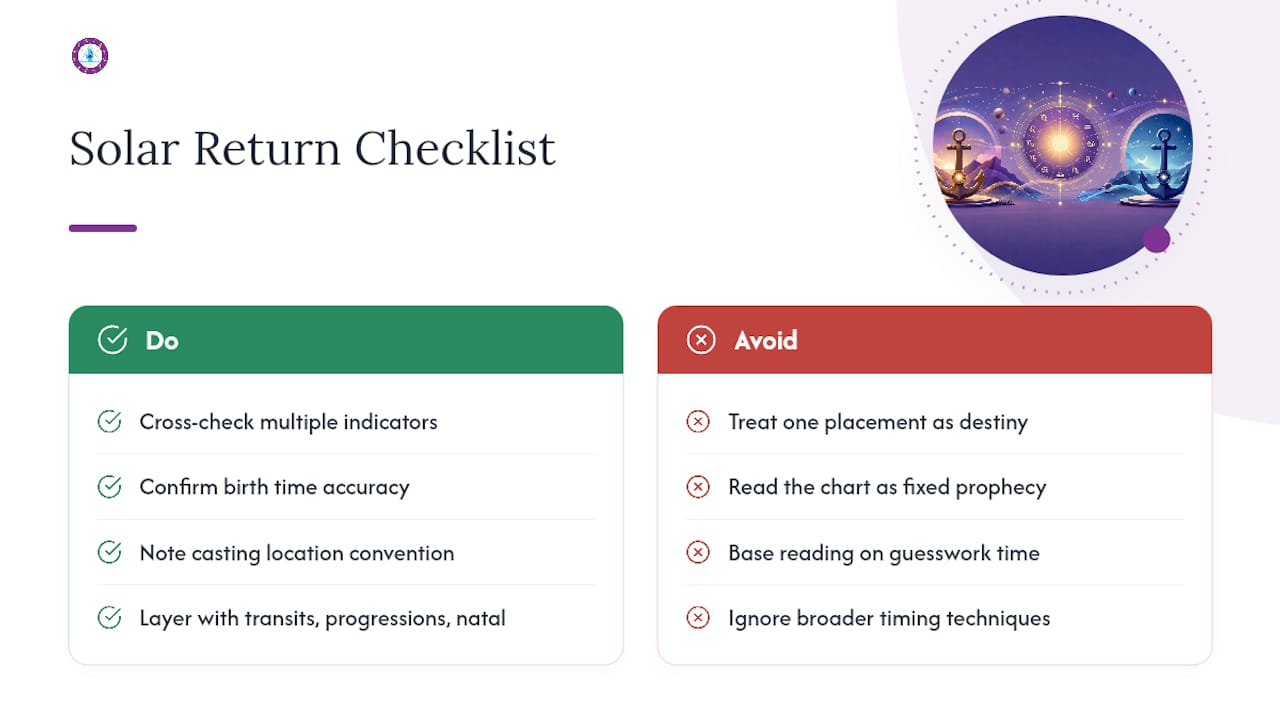
Solar return charts reward careful method, but they also trip people up in predictable ways. The biggest issue is treating a single placement as destiny. A Pluto transit through the 5th house doesn’t automatically mean pregnancy or a dramatic romance, despite what quick internet summaries often claim. Reliable interpretation comes from multiple indicators agreeing with each other, not one striking placement read in isolation.
Precision is the second major hurdle. An uncertain birth time throws off the Ascendant and every house cusp that follows, which means a reading built on guesswork can misidentify the year’s entire arena of focus. The location debate compounds this: casting for birthplace versus casting for wherever you’ll actually be on your birthday can shift emphasis from career to home life or vice versa, and readers rarely realize which convention a given source used.
There’s also a tendency to read solar returns as fixed prophecy rather than a seasonal forecast. A chart that looks intense on paper, heavy Mars energy near the Midheaven, for instance, doesn’t guarantee conflict. It describes available energy and likely pressure points, and how that energy gets used still depends on choices made during the year.
Finally, solar returns work best as one layer among several. A chart read completely apart from transits, progressions, or the natal blueprint loses the context that makes its themes make sense for you specifically rather than for astrology in the abstract.
What Do Solar Return Themes Look Like in Practice?
Solar return themes vary enormously by individual chart, but a few recurring patterns show up often enough to illustrate how the method works.
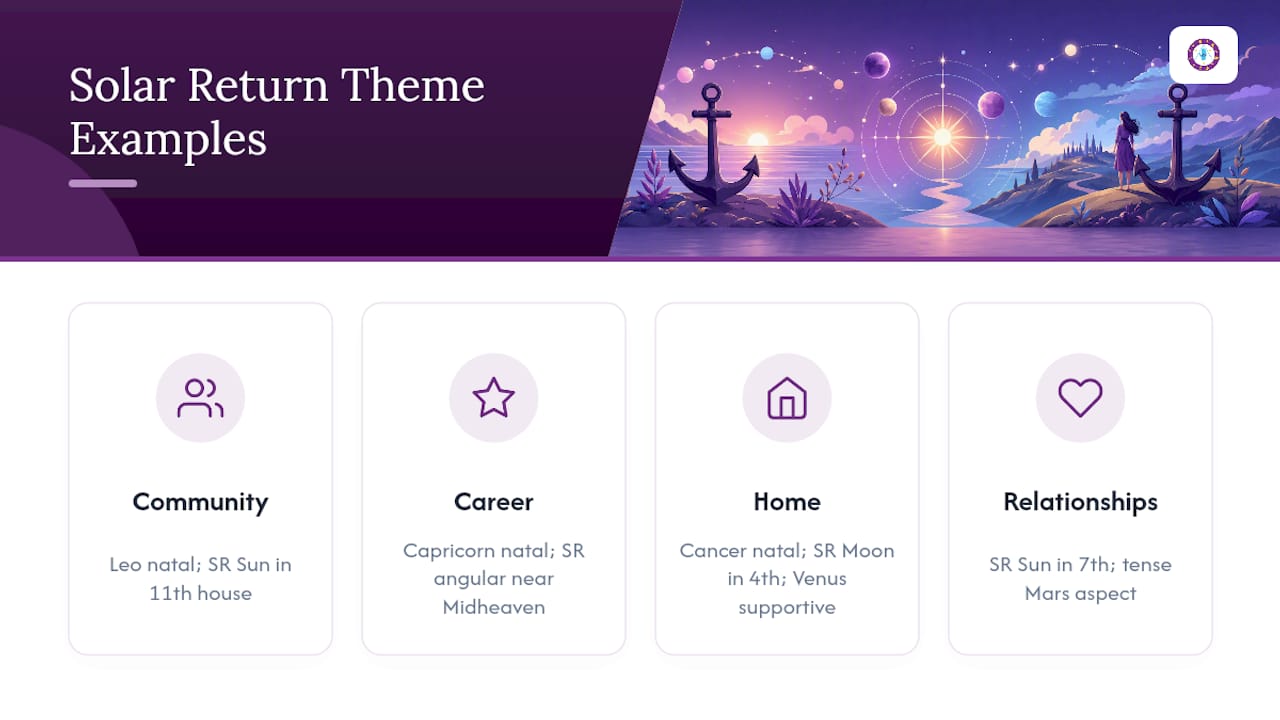
A person with a Leo Sun whose solar return Sun lands in the 11th house often experiences a year organized around community, group projects, or a expanding social circle rather than solo achievement. The Leo drive for recognition doesn’t disappear; it just gets expressed through collaboration instead of the spotlight.
A Capricorn native with solar return angular planets clustered near the Midheaven typically sees career visibility spike, promotions, public recognition, or a shift in professional reputation, whether wanted or not. The natal discipline that defines Capricorn gets tested in public this particular year.
Someone with a Cancer natal Sun whose solar return Moon falls in the 4th house alongside a supportive Venus aspect often reports a year centered on home stability, family bonding, or literally settling into a new living situation with relative ease.
A common life theme across signs involves the solar return Sun landing in the 7th house paired with a tense Mars aspect. This combination frequently marks a year of significant relationship negotiation, not necessarily conflict, but real conversations about commitment, boundaries, or shared responsibilities that can’t be postponed.
These examples aren’t predictions to copy onto your own chart. They show how the same method, Ascendant plus Sun house plus angular emphasis plus aspect quality, produces genuinely different stories depending on what’s actually present in the chart.
An Editorial Note on Reading Your Solar Return Responsibly
Solar returns work best as a compass, not a verdict. The most useful readings inform your intentions for the year rather than pin down fixed outcomes, and professional practice consistently favors reading the return against your natal chart over treating it as a standalone document. This same principle applies to vetted, 24/7 phone consultations where readers are selected for accuracy and depth, not for dramatic pronouncements that don’t hold up against the full chart.
— Jason
Get a Personalized Solar Return Reading by Phone
Casting your own solar return chart is one thing. Interpreting the interplay between your Ascendant, Sun house, angular planets, and natal overlay accurately is another skill entirely, and it’s where a lot of self-taught readings go sideways. Connect with hand-vetted astrology readers who walk through your chart live, on your schedule, without booking a studio visit or waiting weeks for an appointment.

A typical session covers your solar return Ascendant and Sun placement, checks angular planets and key aspects, and maps out which months of your year are likely activation windows based on your Moon and profections. Have your exact birth date, time, and location ready before you call, along with any specific question, career, relationships, or a major decision, so your reader can focus the conversation where it matters most. If you’d rather explore your yearly outlook through a dedicated format, the annual horoscope reading is built specifically for this kind of year-ahead planning. When you’re ready, browse available readings and connect with a reader today.
Where to Cast and Study Your Solar Return Chart
- Astro-Seek’s solar return calculator generates your chart instantly and displays Ascendant, angular planets, and SR-to-natal contacts once you enter exact birth data.
- Big Sky Astrology offers a foundational explanation of the technique itself.
- Heart & Soul Astrology’s tutorial walks through profections alongside the solar return for readers ready to go deeper.
Sources
- How to read a Solar Return chart: a practical guide - AstroCore
- Guide: reading a solar return - Kerykeion
- Solar return chart: how to read your year ahead - Astrolium
- Working with Solar Return charts - Big Sky Astrology
FAQ
How Do I Read My Solar Return Chart?
Start with the Ascendant for the year’s overall tone, then check the Sun’s house for the central theme, followed by the Moon for emotional timing, angular planets for emphasis, and finally overlay it on your natal chart for personal specificity.
What Signs in a Solar Return Indicate Marriage?
No single sign or placement reliably predicts marriage on its own; astrologers look for converging indicators, such as the Sun or Venus in the 7th house, supportive aspects to those points, and a matching signal from the profected lord of the year.
Is Your Solar Return the Same as Your Birthday?
Not exactly. Your solar return is cast for the precise astronomical moment the Sun returns to your natal degree, which can fall a day before or after your calendar birthday and at a different hour each year.
What Does It Mean if Saturn Is in the 8th House on My Solar Return Chart?
Saturn in the 8th house of a solar return often points to a year of serious work around shared finances, debt, inheritance, or deep transformation, requiring patience and structure rather than quick fixes, especially if it’s aspected by other slower-moving planets.