
5 Steps to Tell If Ringing in Ears Is Spiritual

Ear ringing can be a spiritual sign, a medical symptom, or both at once, and the only responsible order is to check the body first. If the ringing is brief, occasional, and tied to a strong thought or feeling, it’s reasonable to explore it as a message from your guides, higher self, or intuition. Persistent, painful, sudden, or accompanied by hearing loss or dizziness ringing should be evaluated medically before considering symbolic meaning. Either way, jot down what was happening the moment it started. That note becomes valuable later.
Key Takeaways
- Ear ringing that persists for days, causes pain, or is accompanied by hearing loss or dizziness requires immediate medical evaluation before considering spiritual interpretations.
- A high, clear tone during ringing often signifies alignment or confirmation, while a dull or irritating sound may indicate tension or unresolved boundary issues.
- Right ear ringing generally relates to external messages or news, whereas left ear signals tend to come from internal intuition or emotional processing, influenced by context.
- Discernment is supported by noting the first thought or image at onset, recording detailed patterns, and asking simple questions like “Is there something I need to notice now?” during a short meditation.
- When medical causes are ruled out, consulting a vetted psychic or spiritual guide can help interpret recurring signs and guide next steps in decision-making.
Table of Contents
- Ringing In Ears Spiritual Meaning: What It Commonly Signals
- Left Ear Ringing Vs Right Ear Ringing Spiritual Meaning
- What Different Faiths And Traditions Say About Ear Ringing
- Tinnitus Or Spiritual Sign? How To Tell The Difference Safely
- A 5-Step Practice For The Next Time Your Ears Ring
- Buddhist, Islamic, And New Age Views On Ear Ringing
- Ear Ringing As Psychic Contact Or Spiritual Awakening
- Chakras And Energy Centers: The Ear-Ringing Connection
- Meditation Techniques For Interpreting The Ringing
- How Practitioners Actually Approach Ear-Ringing Reports
- Want Help Making Sense Of A Recurring Sign?
- Sources
- FAQ
Ringing In Ears Spiritual Meaning: What It Commonly Signals
Across spiritual traditions, ear ringing is usually read as an attention signal. Something, whether you call it a spirit guide, an angel, your higher self, or your own intuition breaking through the noise of daily life, is trying to get you to stop and notice. The ringing itself isn’t the message. It’s the knock on the door.
Most spiritual interpretations of ear ringing cluster around a handful of recurring themes. A sudden ring during a conversation or a quiet moment often gets read as confirmation that a thought you just had is true or worth acting on. Other times it functions as a call to act, nudging you toward a decision you’ve been avoiding. Some readers treat it as a warning to slow down or reconsider a path, while others describe it as an energetic shift, a marker that your vibration or awareness just changed. And frequently it’s simply an invitation to listen, a prompt to quiet your mind and pay attention to what comes next.
- Confirmation: you were just thinking something true or important
- Call to act: a nudge toward a decision or conversation you’ve delayed
- Warning: a cue to pause before moving forward
- Energetic shift: a sign your awareness or environment just changed
- Invitation to listen: a prompt to get quiet and tune in
Tone and timing matter as much as the fact of the ringing. A high, clear ring often reads as positive, something like alignment or a spiritual “download,” while a low, dull, or irritating tone tends to get interpreted as tension, friction, or an unresolved boundary issue. A ring that shows up while you’re calm and reflective carries a different weight than one that hits during an anxious, chaotic moment. Nighttime ringing gets tied more often to dreams, ancestors, or the subconscious; daytime ringing tends to get linked to immediate, waking-life guidance.
This isn’t a new idea dressed up in modern spiritual language. The Roman naturalist Pliny the Elder recorded the belief that a ringing ear meant someone, somewhere, was talking about you, and that folk rule shaped centuries of European superstition about which ear meant praise and which meant criticism. The specific stories change by culture, but the underlying instinct, that a physical sensation in the body can carry outside information, shows up again and again across history.
Pro Tip: Before you interpret anything, note the very first thought or image that crossed your mind the second the ringing started. That first impression, before your rational mind edits it, is usually the clearest clue you’ll get.
Left Ear Ringing Vs Right Ear Ringing Spiritual Meaning
Direction is one of the oldest and most consistent variables in ear-ringing folklore. The general rule, repeated across many modern spiritual sources, treats the right ear as external and outward facing, tied to action, receiving messages from other people, or news headed your way. The left ear is treated as internal, tied to intuition, emotional processing, and messages arriving from within rather than from the outside world.
A right ear ring might show up right before someone mentions your name, or while you’re weighing a decision that involves other people, like a job offer or a difficult conversation. A left ear ring, by contrast, tends to arrive during quiet, internal moments, when you’re processing grief, working through a relationship pattern, or sitting with a gut feeling you haven’t voiced yet.
Context changes the reading more than the side does. If your right ear rings while you’re in an argument, that’s a very different signal than the same ring hitting while you’re celebrating good news. Emotion at the moment of onset often tells you more than the direction alone.
When you’re not sure which interpretation fits, run through a short checklist:
- Who was with you, if anyone, when it happened, and what were they saying or doing?
- What were you actively thinking about in the seconds before the ring started?
- What was your very first impression or gut reaction once you noticed it?
- What’s your emotional state right now, calm, anxious, hopeful, unsettled?
Whichever answer feels the most immediate and honest is usually the one worth trusting. Traditions disagree on the specifics, some flip the right/left rule entirely depending on region and era, so personal resonance matters more than memorizing a universal chart.
What Different Faiths And Traditions Say About Ear Ringing
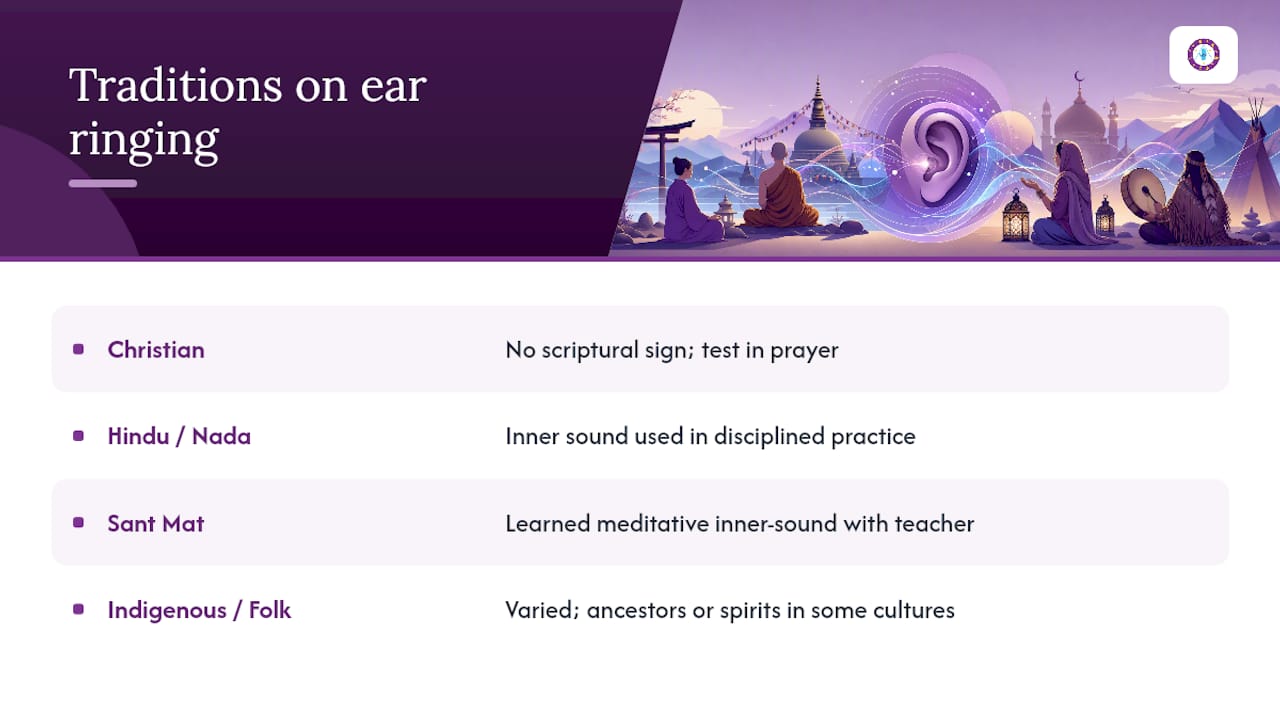
Spiritual explanations of ear ringing vary widely depending on which tradition you’re drawing from, and none of them agree on a single fixed rule.
Christian perspective. Scripture doesn’t define ear ringing as a supernatural sign anywhere in its text. Christian-oriented analyses of the topic point out that while the Bible has strong themes around hearing, listening, and discernment, there’s no verse that ties a literal ringing sensation to a divine message. Writers in this space consistently encourage prayer and testing the spirit rather than treating a physical sensation as doctrine. If you’re spiritually inclined and Christian, the safer framework is to bring the experience to prayer and community discernment instead of assigning it fixed meaning on your own.
Hindu and Nada traditions. In Hindu meditation practice, particularly the Nada Yoga tradition, an inner sound is treated as a genuine access point to deeper states of awareness, something cultivated through disciplined practice rather than something that just happens to you once and means everything.
Sant Mat and mystic paths. Sant Mat and related Shabd traditions treat the “inner sound” as a serious, learnable meditative phenomenon, not a casual omen. Practitioners work with a teacher over time to access and interpret that inner sound consistently. An occasional ring in daily life isn’t treated as equivalent to that trained practice, though it can be a gentle nudge toward exploring meditation more seriously.
Indigenous and folk traditions. Beliefs vary enormously by region and community, but many indigenous and folk traditions connect ear ringing to ancestors reaching out, spirits attempting contact, or informal social signaling, similar to the old European “someone’s talking about you” idea. There’s no single universal indigenous interpretation, and it’s worth being cautious about flattening distinct cultures into one generic “ancient wisdom” narrative.
The throughline across all of these traditions: context and personal discipline matter more than a one-size-fits-all rulebook.
Tinnitus Or Spiritual Sign? How To Tell The Difference Safely
Before you lean into any spiritual reading, rule out the physical explanation. Ringing, buzzing, or humming in the ears has a clinical name, tinnitus, and it’s extremely common. Everyday causes include loud noise exposure, earwax buildup, high blood pressure, certain medications, and sinus or ear infections. Most cases are mild and pass on their own.
Some symptoms deserve a doctor’s attention before anything else:
- Ringing that persists for days rather than minutes
- Sudden hearing loss in one or both ears
- Ear pain, pressure, or discharge
- Dizziness, vertigo, or balance problems alongside the ringing
- Ringing that started after a head injury or loud concert
If any of those apply, see an audiologist or physician, and go to an ER for sudden hearing loss paired with dizziness. Spiritual interpretation makes the most sense when the ringing is brief, occasional, and tied to a clear emotional or mental moment, not when it’s a constant, disruptive presence in your daily life.
Practitioner-oriented research on this topic recommends a combined, sequenced approach: rule out physiological causes first, record what happened, and only then apply spiritual discernment. That order protects you from missing a treatable medical issue while still leaving room for meaning once the body checks out clear.
A 5-Step Practice For The Next Time Your Ears Ring
You don’t need a ritual to interpret ear ringing, just a short, repeatable process you can run through in under a minute.
- Pause and breathe. Stop what you’re doing for a few seconds. Check for an obvious physical trigger, loud noise nearby, sudden pressure change, ear pain, before assuming anything spiritual is happening.
- Note your first impression. What thought, image, or feeling crossed your mind the instant you noticed the ring? Write it down or say it out loud immediately, before you second-guess it.
- Record the details. Keep a simple log: timestamp, which ear, pitch and quality (high and clear versus low and dull), what you were doing, your first thought, and any physical sensations that came with it.
- Ground and ask. Take one slow breath, place a hand over your heart or ear, and silently ask a clarifying question, something like “Is there something I need to notice right now?” Journal or pray briefly afterward if that fits your practice.
- Decide your next move. If the pattern keeps repeating or the feeling stays unresolved, decide whether you need an audiologist for the physical symptom or a trusted, vetted spiritual reader for interpretive clarity.
Pro Tip: Keep your log in the notes app on your phone rather than a separate journal. You’re far more likely to actually record the moment if it takes ten seconds instead of finding a notebook.
Over a few weeks, patterns tend to surface on their own, certain situations, times of day, or emotional states that consistently line up with the ringing. That pattern is often more revealing than any single incident.
Buddhist, Islamic, And New Age Views On Ear Ringing
Outside the traditions already covered, a few other frameworks shape how people interpret ear ringing today.
In Buddhist thought, sensations like ringing are generally approached through the lens of impermanence and mindful observation rather than fixed omens. The practice isn’t to decode the sound as a message from outside, but to notice it arise, observe it without attachment, and let it pass, treating it as one more object of awareness during meditation rather than a symbol requiring interpretation.
Islamic tradition, similar to Christianity, doesn’t have an established doctrinal position treating ear ringing as a supernatural sign. Interpretation of unusual bodily sensations tends to be approached with caution, with an emphasis on turning to prayer and trusted religious guidance rather than folk superstition.
New Age and modern metaphysical frameworks are where most of today’s popular interpretations actually come from, ideas about frequency shifts, spiritual awakening, and energetic “upgrades.” In this framework, ringing is often described as a sign that your vibration is changing, sometimes linked to concepts like ascension or expanding awareness. These ideas are widely shared online but aren’t tied to any single ancient lineage. Treat them as one modern lens among many rather than an established tradition with deep historical roots.
Ear Ringing As Psychic Contact Or Spiritual Awakening
Within psychic and mediumship circles, ear ringing is frequently described as one of the more common ways spirit communication shows up in daily life. The idea isn’t that a spirit is literally producing a sound in your ear. It’s that the sensation functions as a trigger, a cue that pulls your attention out of autopilot and into a more receptive state where subtler information can come through.
Some people report ear ringing intensifying or becoming more frequent during periods they describe as spiritual awakening, when intuition sharpens and they start noticing synchronicities they’d normally miss. In this framework, the ringing isn’t the awakening itself. It’s more like a bell going off, alerting you that something in your perception is shifting and it’s worth paying closer attention to your dreams, gut reactions, and recurring thoughts during that stretch of time.
This is also where clairaudience, the psychic sense tied to hearing, gets discussed most often. People who describe themselves as clairaudient sometimes report ear ringing as one of several auditory sensations, alongside hearing a name called with no one there, or catching a clear inner “voice” offering guidance. None of this is measurable in a clinical sense, so it’s worth holding loosely rather than treating it as proof of anything. But as a subjective marker that something in your inner awareness is active, plenty of intuitive practitioners take it seriously.
Chakras And Energy Centers: The Ear-Ringing Connection
In energy-based frameworks, ear ringing gets connected most often to the throat chakra and the third eye chakra. The throat chakra governs communication and self-expression, so a ring is sometimes read as a sign that something you’ve been holding back needs to be voiced, a conversation, a truth, a boundary. The third eye chakra governs intuition and inner vision, so ringing is also read as a marker of that center becoming more active, sharper hunches, more vivid dreams, a stronger pull toward inner knowing.
Some practitioners connect a higher, clearer tone to the crown chakra, describing it as a sign of connection to broader awareness or spiritual insight, while a lower, more grounding tone gets tied back down to the root or throat. There’s no universally agreed chart mapping tone to chakra. Different energy-healing schools describe the correspondences differently, so this is best treated as one interpretive lens rather than settled fact.
If chakra language resonates with you, the practical takeaway is simple: when your ears ring, check in with your throat and your intuition. Is there something you’re not saying? Is there a hunch you’re ignoring? That question alone often does more good than trying to pin the sensation to one exact energy center.
Meditation Techniques For Interpreting The Ringing
A short, focused meditation practice can turn a confusing sensation into useful information, and you don’t need advanced training to try it.
Start by sitting quietly the next time your ears ring, or shortly after. Close your eyes, take three slow breaths, and simply observe the sound without trying to make it stop or change. This mirrors the Nada Yoga approach of treating inner sound as an object of focused attention rather than background noise to be ignored. Ask yourself gently: what was I thinking about right before this happened? Let the answer surface without forcing it.
A brief body scan afterward helps, too. Move your attention slowly from your head down through your chest and stomach, noticing any tension, warmth, or unease. Physical sensations elsewhere in the body often carry as much interpretive weight as the ringing itself.
Journaling immediately after this short practice locks in details you’ll otherwise forget within an hour. Even two or three sentences, what you heard, what you thought, how your body felt, builds a record you can look back on weeks later to spot patterns.
How Practitioners Actually Approach Ear-Ringing Reports
People calling in about ear ringing usually fall into one of two groups: those who’ve already seen a doctor and want help making sense of the experience, and those who haven’t thought to check medically at all. Both groups deserve the same starting point.
Responsible practitioners treat ear-ringing questions with medical caution first, interpretation second. A caller describing persistent or painful ringing gets encouraged toward an audiologist before anything else. Once that’s ruled out, an experienced reader can help sort through context, timing, and emotional resonance to offer clarity, not a diagnosis, but a grounded perspective on what the moment might mean.
A short reading can’t tell you what’s happening in your inner ear. What it can offer is a second set of eyes on the pattern you’re seeing, some options for how to respond, and a sense of grounding if the experience has left you unsettled. Whatever comes up in a reading is worth testing against your own instincts and the recorded details from your log, not accepted as final word.
— Jason
Want Help Making Sense Of A Recurring Sign?
Once you’ve ruled out a medical cause and you’re still sitting with a ring that felt like more than noise, a short conversation can help you sort through what you noticed. You can connect with hand-vetted psychic readers who are available 24/7 whenever the question is fresh in your mind.

A spiritual guidance reading by phone is built for exactly this kind of moment: an unusual experience you want a grounded second opinion on, not a medical answer, but a clear, interpretive conversation about timing, context, and what to do next. If the ringing keeps circling back to a decision you’ve been avoiding, a career psychic reading or love psychic reading can help you work through the specific situation the sign seems tied to. Readings here are interpretive support alongside your own judgment and any medical care you’ve already sought, never a replacement for either. Pick up the phone when you’re ready and talk it through with a reader who’s heard this exact question before.
Sources
For the Christian perspective, Bible Answers Project walks through why Scripture doesn’t treat ear ringing as a doctrinal sign. For the right/left symbolic framework, Parade’s spiritual explainer covers folklore roots and modern healer interpretations. For the Sant Mat and Nada tradition, this academic paper on the Santmat movement offers real depth. If ringing persists, skip the research and call an audiologist first, then return to these sources for context once you’re medically cleared.
- Spiritual Ringing in the Ears: What the Bible Says
- Left ear ringing: spiritual meaning and message it brings — Parade
- The modern monastic Santmat movement of Bihar: building bridges between Sanatana Dharma and Sant-Mat
FAQ
What does the Bible say about ears ringing?
The Bible doesn’t directly address ear ringing as a supernatural sign anywhere in its text. Christian analyses of the topic consistently point believers toward prayer and discernment rather than treating the sensation itself as a message from God.
What does a high-pitched sound in the ear mean spiritually?
A high, clear tone is often read as a positive signal, something like spiritual alignment, confirmation, or an intuitive “download” coming through. Practitioners contrast this with a low, dull, or irritating tone, which tends to get interpreted as tension or an unresolved issue needing attention.
What does ringing in your ears signify?
Spiritually, it’s most often read as an attention signal, a nudge to pause, listen, or notice something important happening in your thoughts or environment. Medically, it’s usually tinnitus, commonly linked to noise exposure, earwax, blood pressure, or medication, so persistent ringing should be checked by a doctor before you interpret it symbolically.
Is ringing in the right ear good or bad luck?
Neither, definitively. Folk tradition tends to treat the right ear as external and action-oriented, sometimes tied to news or being talked about, but interpretations vary by culture and era, and context at the moment it happens usually matters more than the side alone.
How do I know if my ear ringing needs a doctor instead of a spiritual reading?
Persistent ringing lasting days, sudden hearing loss, pain, or dizziness are red flags that call for an audiologist or physician right away. Brief, occasional ringing tied to a clear thought or feeling is reasonable to explore spiritually, ideally after medical causes have already been ruled out.