Answer Three Questions to Choose Numerology or Astrology
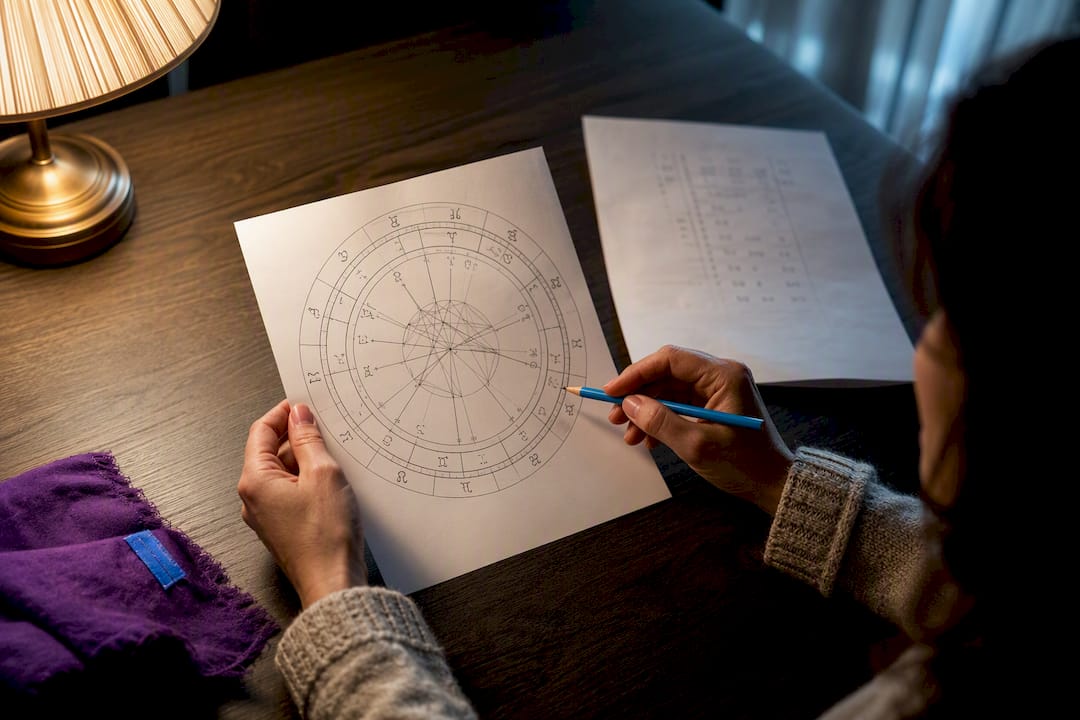
For fast, practical clarity on a specific decision, numerology usually gets you there quicker. For nuanced timing and relationship depth, astrology holds the edge, though it demands more of your data. Most people get the richest picture using both, since one tends to sharpen what the other only sketches.
Key Takeaways
- If you lack exact birth time, numerology provides reliable insights, while astrology’s accuracy heavily depends on precise birth data.
- Numerology’s cyclical timing suits broad planning, whereas astrology’s specific transits help pinpoint optimal windows for major decisions.
- Astrology offers detailed personality and relationship maps through a natal chart, but requires accurate birth location and time, with small errors causing significant shifts.
- Numerology emphasizes core numbers like Life Path and Personal Year, which are quick to calculate and useful for general tendencies, but less precise on timing.
- Combining both systems with a layered approach enhances confidence, especially when numerology’s broad themes align with astrology’s transit insights.
Table of Contents
- Numerology vs Astrology: A Side-By-Side Comparison
- How Astrology Works: What a Natal Chart Actually Tells You
- How Numerology Works: Core Numbers and Yearly Cycles
- Which System Is More Accurate? Defining the Question First
- Choosing Between Numerology and Astrology: Three Quick Questions
- Combining Both Systems: A Practical Workflow
- The Bottom Line: Start Small, Then Go Deeper
- Where Numerology and Astrology Actually Came From
- Myths That Trip Up Beginners in Both Systems
- Why Scientists Remain Skeptical of Both Systems
- Get a Live Numerology or Astrology Reading by Phone
- A Personal Note on Using These Systems Well
- Sources
Numerology vs Astrology: A Side-By-Side Comparison
The two systems ask different things of you before they give anything back. Astrology wants your exact birth time and place, because a natal chart built on Sun, Moon, rising sign, planets, houses, and aspects shifts meaningfully with even a few minutes of error. Numerology only needs your birth date and full legal name, making it more accessible when exact birth time is unknown.
The outputs differ just as much:
- Astrology produces a layered chart mapping personality, relationship patterns (synastry), and life timing through transits and progressions.
- Numerology produces a compact set of core numbers, Life Path, Expression, Soul Urge, plus a repeating Personal Year cycle that runs one through nine.
- Astrology’s timing is non-repeating and highly specific to your chart; numerology’s timing is simpler and cyclical, which makes it easier to plan around but less granular.
- Accessibility tilts firmly toward numerology. You can calculate your Life Path number in under a minute, while a proper chart reading benefits from an experienced interpreter.
If you want something you can use today with information you already have memorized, numerology wins on convenience. If you want depth on why a particular month feels heavy or when a relationship is likely to shift, astrology’s transit system gives you more to work with, provided your birth time is accurate.
How Astrology Works: What a Natal Chart Actually Tells You
A natal chart is a snapshot of the sky at the exact moment you were born, mapped from your birthplace. It plots the Sun, Moon, and rising sign alongside the other planets, then organizes them into twelve houses and the angles (aspects) they form with each other. Your Sun sign gets the most airtime in pop culture, but it’s really just one piece; your Moon shapes emotional instinct, your rising sign colors how others perceive you, and the houses show where each planetary energy plays out, career, relationships, home life, and so on.
Birth time matters more than most people expect. Because the sky rotates roughly one degree every four minutes, a birth time that’s off by even fifteen minutes can shift your rising sign and reshuffle your houses entirely.
- Transits track how current planetary positions interact with your natal chart, offering a rolling forecast.
- Progressions advance your chart slowly over your lifetime, useful for mapping longer arcs of personal development.
- Synastry overlays two charts to assess relationship compatibility in far more detail than a single number can.
Pro Tip: If you don’t know your exact birth time, ask for your birth certificate from the county recorder’s office where you were born. Many US counties will mail or email a certified copy for a small fee, and it’s often the fastest way to unlock a full chart reading instead of a partial one.
How Numerology Works: Core Numbers and Yearly Cycles
Numerology reduces two pieces of information, your birth date and your full name at birth, into a set of core numbers that describe personality, purpose, and timing. Unlike astrology, it doesn’t need a clock or a map, just a calendar and a name.
- Life Path Number: calculated from your full birth date, it’s considered the closest numerology equivalent to a Sun sign, describing your broad life direction.
- Expression Number: derived from every letter in your birth name using a Pythagorean or Chaldean number system, describing how you naturally show up in the world.
- Soul Urge Number: calculated from the vowels in your name, pointing toward inner motivation and desire.
- Birthday Number: a smaller number pulled from just the day you were born, adding a minor personality accent.
- Personal Year Number: recalculated annually by adding your birth month and day to the current year, cycling through themes from new beginnings (Year 1) to completion (Year 9).
Because numerology relies on name-based calculations that astrology doesn’t touch at all, it offers a genuinely different lens, useful for weighing a name change, naming a business, or getting a fast read on the year ahead before making a big move.
Which System Is More Accurate? Defining the Question First
“Accuracy” means something different for each system, and conflating the two definitions is where most comparisons go wrong. For astrology, accuracy often means precision; does the chart data (birth time, location) produce a reading specific enough to nail relationship timing or a career shift down to the month. For numerology, accuracy tends to mean resonance: does the Life Path or Personal Year description feel broadly, reliably true across many different people who share that number.
- Astrology offers higher granularity when your birth data is complete, particularly for synastry-based relationship work.
- Numerology is faster and more consistently descriptive for broad tendencies, even with incomplete information.
- Neither system carries mainstream scientific validation, so treat both as interpretive tools rather than predictive instruments.
The honest takeaway: usefulness depends more on personal resonance and the skill of whoever is reading your chart or numbers than on the system itself.
Choosing Between Numerology and Astrology: Three Quick Questions
You don’t need a philosophy degree to pick a starting point. Ask yourself these three questions in order:
- Do you know your exact birth time? If not, numerology, or a partial astrology reading using just your Sun and Moon, is your realistic option.
- Do you need precise timing for a decision (a move, a proposal, a career change)? Astrology’s transit system is built for this; numerology’s Personal Year gives you a broader window instead of a specific date.
- Are you weighing a name, business, or identity decision? Numerology’s Expression and Soul Urge numbers speak directly to this in a way astrology doesn’t.
If you’re naming a child or rebranding a business, start with numerology. If you’re timing a wedding date or trying to understand relationship friction, lean toward astrology.
Pro Tip: Calculate your Life Path number first, it takes five minutes and costs nothing. If the description resonates, that’s your cue to invest in a deeper astrology reading for the details numerology can’t reach.
Combining Both Systems: A Practical Workflow
Practitioners rarely treat these as competing systems. A more effective approach starts broad and narrows in:
- Step one: calculate your Life Path and current Personal Year number for quick orientation on the year’s overall theme.
- Step two: layer in a natal-chart check, even a partial one, to identify which specific weeks or months carry active transits.
- Step three: look for overlap. If your Personal Year 5 (change) lines up with a Jupiter transit hitting your career house, that convergence is a stronger planning signal than either system alone.
That’s the real value of cross-referencing: agreement between two independent methods builds more confidence than either offers by itself.
This is where a live reading earns its cost over a free app. Phonepsychicreaders vets its numerology and astrology readers through a selective screening process, so you’re not left interpreting an Expression number alone at midnight. Readers are available 24/7, meaning you can get a same-day session when a decision window is closing fast, and a real conversation catches nuance that a generated PDF chart never will.
The Bottom Line: Start Small, Then Go Deeper
Numerology gives you speed and clarity with minimal input. Astrology gives you depth and timing precision once you have accurate birth data. Neither replaces the other, and combined, they cover each other’s blind spots.
Start by calculating your Life Path number today. If you know your birth time, follow up with a short natal reading. If timing feels urgent, book a short phone session instead of waiting on a free calculator to guess.
Where Numerology and Astrology Actually Came From
Astrology’s roots trace back roughly 4,000 years to Babylonian sky-watchers, who tracked planetary movement against the backdrop of what became the zodiac. The Greeks systematized it further, layering in philosophy and mythology, and by the time it reached medieval Europe and the Islamic Golden Age, astrology was treated as a legitimate branch of natural science, taught alongside astronomy and medicine.
Numerology’s lineage is murkier but often credited to Pythagoras and his followers in ancient Greece, who believed numbers held vibrational and mystical properties beyond simple counting. Similar number-symbolism traditions appeared independently in ancient China, India (through Vedic numerology), and Hebrew mysticism via Kabbalah’s gematria, which assigns numeric values to letters much like modern Expression numbers do today.
Both systems traveled through centuries of suppression and revival. Astrology fell out of favor during the Enlightenment as astronomy split from it as a hard science, only to resurge in the 20th century through newspaper horoscopes and, later, apps. Numerology stayed smaller and more niche, often folded into broader New Age movements starting in the 1970s.
What’s worth noting is that neither system emerged in isolation. Cultures on opposite sides of the world independently arrived at the idea that dates, names, and numbers carry meaning beyond their literal value, which says something about a universal human instinct to find pattern and order rather than about either system’s factual validity.
Myths That Trip Up Beginners in Both Systems
The biggest misconception about astrology is that it’s just your Sun sign. Twelve generic personality boxes make for easy magazine content, but a full chart involves the Moon, rising sign, and nine other planets, each placed in a specific house. Reducing astrology to “I’m a Scorpio, so…” throws away most of the system’s actual detail.
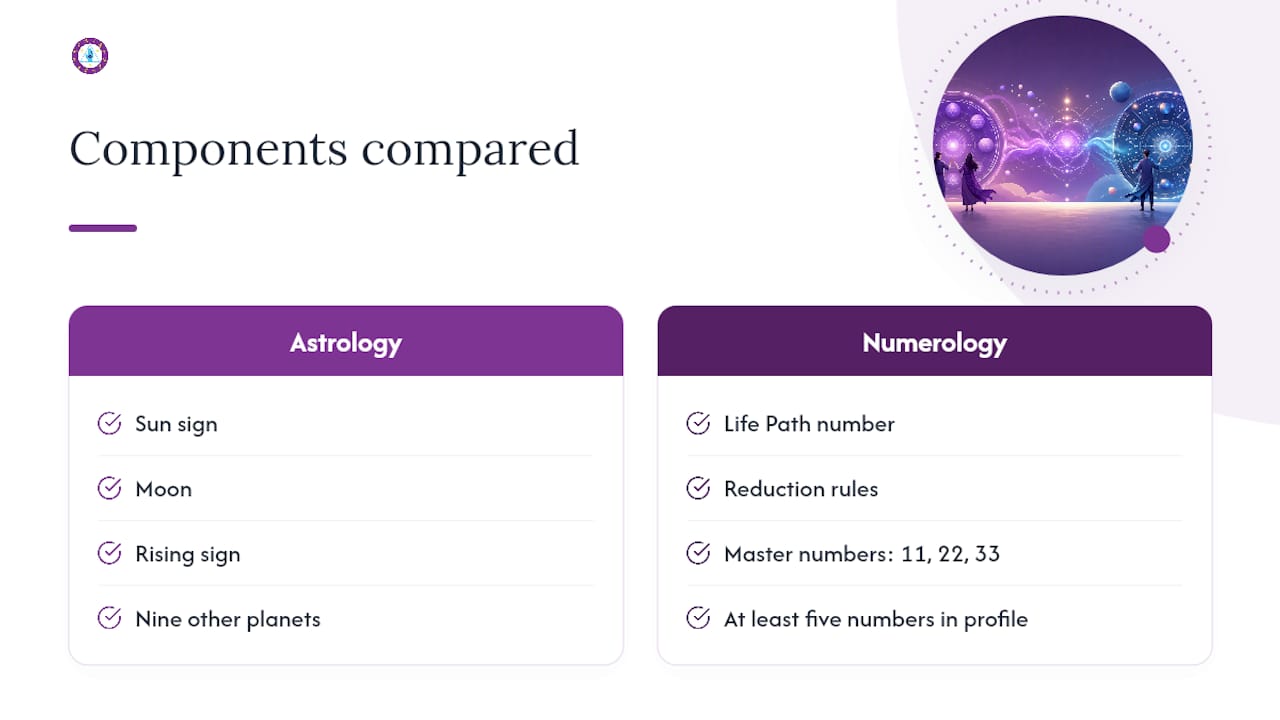
Numerology gets the opposite treatment: people assume it’s too simple to matter. In reality, calculating a Life Path number correctly involves specific reduction rules (master numbers 11, 22, and 33 aren’t collapsed the way other double digits are), and a full profile includes at least five distinct numbers, not just one.
A shared myth across both systems is the belief that they predict fixed, unchangeable outcomes. Neither astrology’s transits nor numerology’s Personal Year cycles claim to lock in a specific event; they describe themes and windows, not guarantees. Treating either system as deterministic, “I’m doomed because Mercury is retrograde”, misunderstands how practitioners actually use them.
Another common mix-up: confusing numerology with tarot. Astrology vs tarot comparisons pop up often in searches, but tarot draws on randomized card imagery for situational insight, while numerology works from fixed calculations tied to your birth data. They can complement each other in a reading, but they’re built on entirely different mechanics.
Why Scientists Remain Skeptical of Both Systems
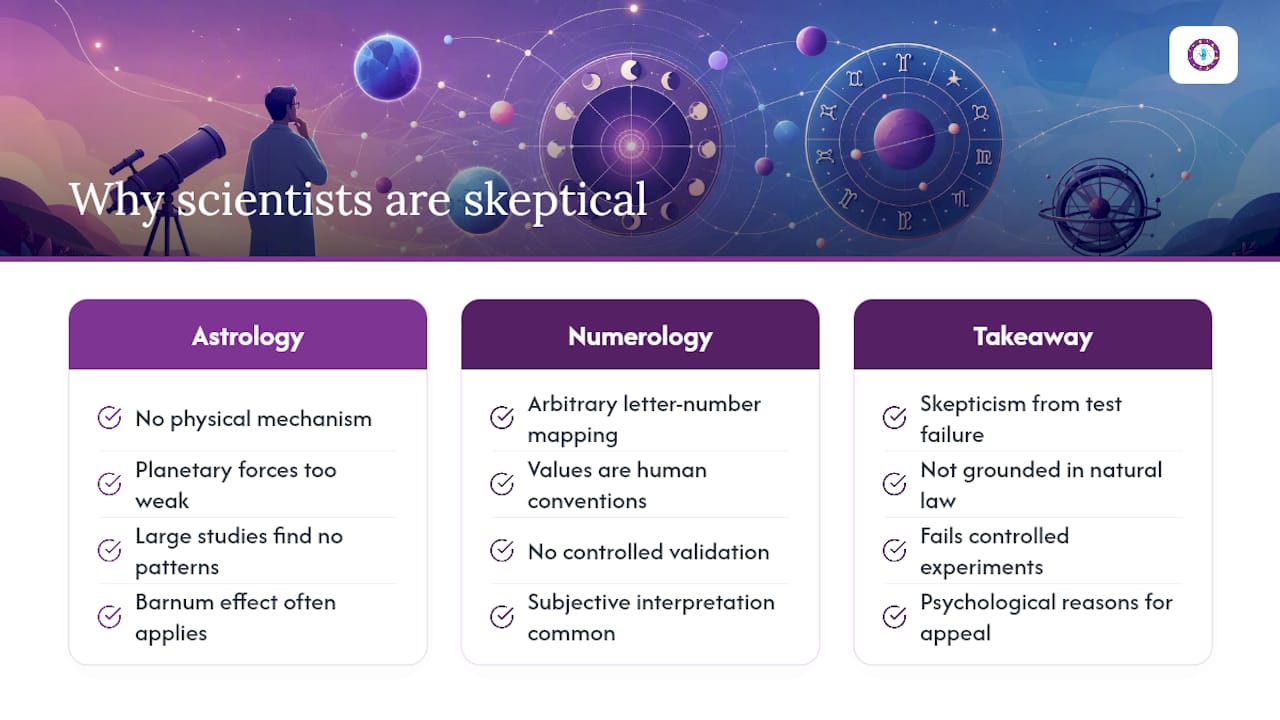
Neither astrology nor numerology has produced results that hold up under controlled, peer-reviewed testing. The most cited scientific critique of astrology points to the lack of a physical mechanism, planetary gravitational or magnetic influence at the distances involved is far too weak to shape personality or events in any measurable way. Large-scale studies attempting to correlate sun signs with personality traits or career outcomes have consistently failed to find statistically meaningful patterns.
Numerology faces a simpler critique: it’s a numerical system applied to an alphabet that was itself invented arbitrarily. Critics point out that assigning values to letters (A=1, B=2, and so on) is a human convention, not a discovered natural law, which makes the resulting “vibrations” a matter of interpretation rather than measurement.
That said, dismissing both as meaningless overlooks why people keep returning to them. Psychologists often point to a version of the Barnum effect, the tendency to see vague, general statements as personally accurate, as a partial explanation for why readings feel true. But that doesn’t fully explain the more specific, falsifiable-feeling moments many people report, where a transit or Personal Year description lines up with an event they didn’t mention to the reader beforehand.
The fair conclusion sits in the middle: treat both systems as interpretive and reflective tools rather than predictive science, and judge their value by whether they help you think more clearly, not by whether they can survive a controlled experiment.
Get a Live Numerology or Astrology Reading by Phone
Phonepsychicreaders puts a real, vetted reader on the line in minutes instead of leaving you to cross-reference a chart and a number chart on your own at midnight. Every reader goes through a selective screening process before they’re approved, and sessions run 24/7 with a $1/minute trial rate for first-time callers, so testing the waters costs almost nothing.
Pick based on what you actually need. If you want fast clarity on a decision this week, ask for a numerology session. If you’re trying to time a move, a relationship, or a career shift, request an astrology reading instead. Have your full birth date and legal name ready either way, and your exact birth time and location if you know them, since that’s what unlocks a complete chart instead of a partial one.
Ready to get a real answer instead of a generic app result? Browse phone psychic services and connect with a vetted reader now.
A Personal Note on Using These Systems Well
My honest advice: treat both as reflective tools, not verdicts. Calculate your Life Path number this week, then request a short chart reading if your birth time is handy, and compare notes… Use what resonates; question what doesn’t.
— Jason
Sources
- Numerology vs Astrology: What’s the Difference? — SoulChart Blog
- Numerology vs Astrology: Which Should You Use? — Kaxanta
- Astrology vs Numerology: Divination Systems Compared 2026 — Thalira