4 Karmic Relationship Signs: When Therapy or a Phone Reading Helps

If a connection felt instantly familiar, swings between euphoric highs and gutting lows, keeps circling the same unresolved fight, and leaves you emotionally depleted more often than not, you’re likely looking at a karmic relationship. These four signals (instant recognition, the addictive push-pull, repetitive conflict, and burnout) show up across nearly every expert breakdown of the pattern. The sections below explain why they happen and what to actually do about it.
Key Takeaways
- Emotional burnout and repetitive unresolved conflicts indicate the cyclical nature of karmic relationships, rather than their potential for lasting connection.
- Intensity and attraction often stem from the nervous system recognizing familiar patterns, not necessarily soulmate or healthy bonds.
- Dangerous red flags like control, threats, and isolation signal abusive dynamics that require prioritizing safety and professional intervention.
- Breaking free involves establishing boundaries, planning logistics in advance, and working through inner patterns with therapy or outside support.
- Karmic ties form from unresolved childhood trauma or past life lessons, appearing in romantic, friendship, and family relationships through recurring destructive cycles.
Table of Contents
- Signs Of A Karmic Relationship You Can Recognize In Yourself
- Why Karmic Patterns Form In The First Place
- Karmic Bond, Soulmate, Or Something Dangerous?
- Breaking The Cycle: A Practical Plan
- Where Karmic Connections Actually Come From
- Karmic Signs Look Different In Romance, Friendship, And Family
- Personal Growth After A Karmic Relationship
- Where A Phone Reading Fits Into The Bigger Picture
- Sources
Signs Of A Karmic Relationship You Can Recognize In Yourself
Karmic relationships don’t announce themselves as trouble. They announce themselves as destiny, which is exactly what makes them so hard to walk away from.
Instant recognition and the magnetic pull. You meet someone and feel like you’ve known them for years. It feels less like attraction and more like reunion. That intensity is intoxicating, but it’s not proof of a soulmate connection. It’s often your nervous system recognizing a familiar emotional pattern, not necessarily a healthy one.
The addictive push-pull cycle. You break up. You get back together. You break up again. Each reconciliation feels like proof the relationship is meant to be, when it’s actually a loop. Psychology Today identifies this addictive cycle of intense highs and lows as one of the core markers of a karmic dynamic, and it’s the piece people rationalize most.

Repetitive unresolved conflict. You argue about the same thing repeatedly in different ways over time. Nothing gets solved because the argument was never really about the surface topic.
Loss of self and emotional exhaustion. Somewhere in the cycle, you stop recognizing your own preferences. You’ve reorganized your moods, your schedule, even your friendships around managing the relationship. Psych Central lists emotional burnout alongside triggers from past relationships or childhood as consistent features, which tells you this isn’t just relationship fatigue. It’s a pattern doing what patterns do: repeating.
A few other signs tend to show up early and get explained away:
- Feeling an intensity you can’t logically justify within the first few interactions
- Justifying behavior in this partner you’d never accept from anyone else
- Noticing friends or family raise concerns you brush off as “they don’t get it”
- Feeling relief mixed with grief when the relationship ends, rather than simple sadness
- Finding yourself waiting for a version of the person who “shows up” only occasionally
Pro Tip: Keep a one-line log after emotionally charged moments with this person: what happened, how you felt, what you told yourself. Patterns that feel invisible in the moment become obvious after two or three weeks of entries.
Most sources, including mindbodygreen, frame these relationships as temporary catalysts for growth rather than lasting unions. That framing matters. It’s the difference between fighting to fix something and recognizing you’ve already learned what it came to teach.
Why Karmic Patterns Form In The First Place
The pull toward these dynamics isn’t random, and it isn’t really about the other person as much as it’s about what they trigger in you.
Attachment theory offers one clear explanation. If your early relationships taught you that love comes with anxiety or unpredictability, a partner who recreates that instability can feel like home, even when it’s harmful. Trauma reactivation works similarly: someone unconsciously touches an old wound, and the resulting chemistry gets mistaken for fate.
Spiritual frameworks offer a different lens on the same behavior. Many readers interpret these bonds as connections carrying unresolved lessons, sometimes described as originating in a past life. Whether or not you take that literally, the meaning-making function is real. It gives shape to an experience that otherwise just feels chaotic.
A few forces tend to combine here:
- Intense chemistry frequently pairs with unhealthy patterns, which is exactly what makes the dynamic confusing rather than clearly bad
- Unresolved trauma from childhood or prior relationships gets reenacted, often outside conscious awareness
- An outside perspective (a therapist or a skilled, objective reading) can name the loop faster than you can from inside it
Karmic Bond, Soulmate, Or Something Dangerous?
Not every intense relationship is karmic, and not every karmic relationship is safe. Getting this distinction wrong has real consequences.
A karmic bond tends to run hot, short, and unstable. Its purpose is growth through friction, its emotional tone swings between euphoria and distress, and it rarely lasts once the lesson lands. A soulmate connection can also feel intense early on, but it tends to stabilize into mutual respect and steady support over time. Twin flame relationships, as many spiritual writers describe them, sit somewhere in between: intense and mirror-like, meant to accelerate growth, but not always meant to be permanent partnerships either.
Where this gets serious is when intensity crosses into control. Watch for these behavioral red flags:
- Isolation from friends, family, or financial independence
- Monitoring your phone, location, or daily movements
- Threats, intimidation, or punishment after disagreements
- Blame that consistently lands on you for their behavior
- Fear of the person’s reaction as a regular, ongoing state
Cleveland Clinic is direct on this point: intense karmic-style dynamics need to be distinguished from abusive behaviors, and safety and professional help come first when power-and-control patterns appear. If any of the red flags above sound familiar, that takes priority over any spiritual interpretation of the relationship. Contact a domestic violence hotline or a licensed therapist before anything else.
Breaking The Cycle: A Practical Plan
Understanding the pattern intellectually and actually exiting it are two different projects. Here’s a sequence that works better than willpower alone.
- Check for safety first. If any control or abuse indicators from the section above apply, reach out to a professional or crisis resource before attempting to manage this on your own.
- Set one boundary and enforce it. Something concrete: “I won’t discuss this over text after 10 p.m.” Enforcement means following through even when it’s uncomfortable, not just stating the rule.
- Build your exit plan before you need it. Line up where you’d stay, who you’d call, and what logistics (finances, shared belongings) need sorting, so a decision to leave doesn’t stall on details.
- Get outside support during and after. A therapist trained in attachment work can help you see the loop clearly. This is also where an intuitive psychic reading can offer a different vantage point on recurring emotional triggers, though it works best alongside professional care, not instead of it.
- Do the inner work after leaving. Psych Central points to objective outside perspectives as a consistent recommendation for identifying next steps, and that work doesn’t stop the day you walk away. Processing the lesson internally is what actually prevents you from recreating the same dynamic with someone new.
Pro Tip: Write down what you’d tell a close friend in your exact situation. People give better advice to others than to themselves, and this trick short-circuits that gap.
Where Karmic Connections Actually Come From
Most explanations for why these relationships form fall into two categories: spiritual and psychological, and they’re not mutually exclusive.
The spiritual framing treats karmic relationships as connections carrying forward unresolved business, sometimes described as unfinished lessons from a past life. Under this model, you’re drawn to a person because some emotional debt between you (real or symbolic) hasn’t been settled. A past life psychic reading explores this angle directly, looking at recurring themes that seem to trail you from one relationship into the next.
The psychological framing points instead to unresolved patterns from this lifetime: an anxious attachment style formed in childhood, an old relationship wound that never fully closed, or a family dynamic you’re unconsciously trying to rewrite with a new person standing in for the original. Neither framing cancels out the other. A lot of people find real value in holding both at once: using the spiritual lens for meaning, and the psychological lens for actual behavior change.
What both models agree on is that the origin isn’t random. Something specific in your history or your interpretation of your history sets the stage for a partner who fits the pattern precisely. That’s part of why the same person can seem so uniquely compelling to you and unremarkable to a friend watching from outside.
Karmic Signs Look Different In Romance, Friendship, And Family
Karmic dynamics aren’t confined to romantic partners. The same push-pull, same-argument, exhausting-but-magnetic pattern shows up in friendships and family systems too, just with different textures.
In romantic relationships, the signs tend to be the most dramatic: the instant chemistry, the breakup-reconciliation cycle, the identity blur. This is the version most articles describe, largely because the emotional stakes and physical intimacy amplify everything.
In friendships, karmic patterns often look like an on-again, off-again closeness with someone who consistently drains you, followed by guilt every time you try to create distance. You might notice you’re always the one adjusting, apologizing, or initiating repair after a conflict that wasn’t fully your fault.
In family relationships, the pattern can be the hardest to see because it’s been normalized since childhood. A parent-child or sibling dynamic marked by repeating conflict, conditional approval, or a role you can’t seem to shake (peacemaker, scapegoat, the responsible one) often carries the same unresolved-lesson quality as a karmic romance, just stretched across decades instead of months.
Across all three, the tell is the same: a pattern that repeats despite your best efforts to change it, paired with a pull toward the person that feels stronger than the relationship’s actual health would justify.
Personal Growth After A Karmic Relationship
The point of a karmic relationship, if you accept the framing, isn’t the relationship itself. It’s what it forces you to look at.
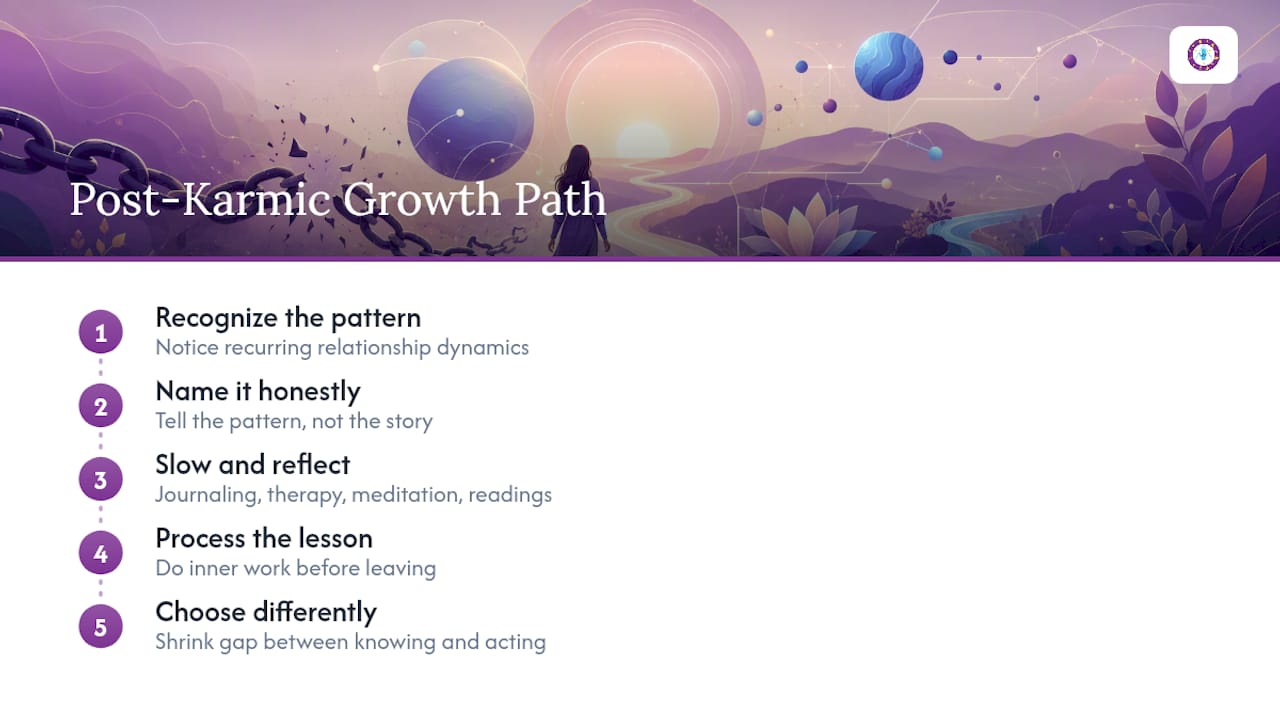
That work usually starts with naming the pattern honestly rather than the story you told yourself while you were in it. Journaling, therapy, and reflective practices like meditation all serve the same function here: they slow down your reaction time enough to notice the moment you’re about to repeat the cycle with someone new. Ending a karmic cycle requires processing the lesson internally; leaving the relationship without that inner work tends to mean meeting the same dynamic again with a different face attached to it.
Spiritual practices, from journaling on recurring themes to seeking a relationship psychic reading for outside perspective, can help surface what the pattern was actually trying to show you. Some people also find grounding value in exploring how astrology or numerology frames their relational tendencies, though it’s worth noting there’s no specific birth date or zodiac sign that definitively marks a connection as karmic. Even partner resources on astrology’s interpretive nature treat these frameworks as reflective tools rather than diagnostic ones, and that distinction matters if you’re using them to make real decisions.
Growth here looks less like a single breakthrough and more like a gradually shrinking gap between recognizing the pattern and choosing not to repeat it.
Where A Phone Reading Fits Into The Bigger Picture
An objective reading can be genuinely useful when you’re too close to a relationship to see its shape clearly. A skilled, hand-vetted reader can often name a repeating energetic pattern faster than you can from inside it, offering a vantage point that’s separate from your own hopes or fears about the outcome.
Phonepsychicreaders only accepts a small percentage of applicants into its network, and readers are available 24/7, which matters when clarity-seeking moments rarely wait for business hours. Callers consistently report feeling grounded and better equipped to make decisions after a session, particularly when they’re deciding whether to stay, leave, or simply understand what they’ve been circling for months.
That said, a reading is not a substitute for therapy or crisis support. If safety, control, or abuse are part of the picture, professional help comes first, always. When the situation calls for relationship clarity rather than crisis intervention, a phone psychic consultation can be a genuinely useful complement to the inner work already underway.
— Jason
Sources
- 8 Signs of a Karmic Relationship (Psych Central)
- What Is a Karmic Relationship? (mindbodygreen)
- What is a karmic relationship? (Cleveland Clinic)