
Jealousy Spiritual Meaning: 8 Lessons Across Traditions and Guidance

Jealousy is a messenger, not a moral failure. It shows up to point at an unmet need, a place where you’re gripping too tightly, or a piece of your identity that feels unsteady. The spiritual meaning of jealousy lies in what it reveals about your attachments, not in what it says about your character. Your first move: notice the feeling, take one slow breath, and ask yourself what you actually want.
Key Takeaways
- Most jealousy stems from personal desires or fears of lack, and recognizing which type you experience guides appropriate spiritual and practical responses.
- Spiritual practices such as naming feelings, cultivating gratitude, and practicing acts of service can transform jealousy into growth opportunities.
- Repeated patterns of jealousy require ongoing self-awareness, community support, and simple routines to rewire long-term emotional responses.
- Harmful jealousy includes controlling behaviors and escalations that threaten relationships, requiring boundary setting and professional help if necessary.
- External tools like psychic readings can offer clarity and insight when internal reflection fails to break persistent jealousy cycles.
Table of Contents
- What Jealousy Signals on a Spiritual Path
- How Different Traditions Understand the Spiritual Root of Jealousy
- 8 Spiritual Lessons Jealousy Can Teach You
- Practical Spiritual Practices to Transform Jealousy
- When Jealousy Crosses the Line Into Harm
- How a Live Spiritual Reading Can Help You Work Through Jealousy
- Beyond Christianity and Bhakti: Other Traditions’ Take on Jealousy
- Jealousy and Shadow Work: What Your Envy Is Hiding
- Staying Grounded: Keeping the Growth After Jealousy Fades
- A Note on Working With Jealousy Instead of Against It
- A Practical Next Step When Jealousy Feels Stuck
- Sources
What Jealousy Signals on a Spiritual Path
Jealousy carries information. Treat it as data about your inner life rather than proof that something is wrong with you, and the whole experience shifts. You stop fighting the feeling and start reading it.
There are two directions jealousy tends to point. Inward-facing jealousy usually flags a sense of lack or insecurity, the fear that you’re falling behind or that you’re not enough as you are. Outward-facing jealousy tends to protect something you already have, like a relationship or a role, and it flares up when that thing feels threatened. Knowing which kind you’re dealing with changes what you do next.
Spiritual communities have their own particular jealousy triggers. Someone else gets praised for a meditation practice you’ve worked on for years. A friend’s healing journey gets public recognition while yours stays quiet. Another member of your sangha or congregation seems to have “arrived” at a peace you’re still chasing. These moments sting precisely because they touch something real: your own desire for growth, connection, or acknowledgment.
When jealousy surfaces, a few honest questions do more good than trying to suppress it:
- What do I actually want here, underneath the sting?
- Where am I holding on too tightly, and to what?
- Is this feeling protecting something real, or reacting to an old fear?
- What would it look like to want this for myself without resenting them for having it?
Answering these questions honestly, even imperfectly, turns jealousy from a source of shame into a genuine spiritual lesson of jealousy: a signal worth following rather than burying.
How Different Traditions Understand the Spiritual Root of Jealousy
Every major spiritual framework has a distinct way of naming jealousy and prescribing a response to it, and each one adds something useful.
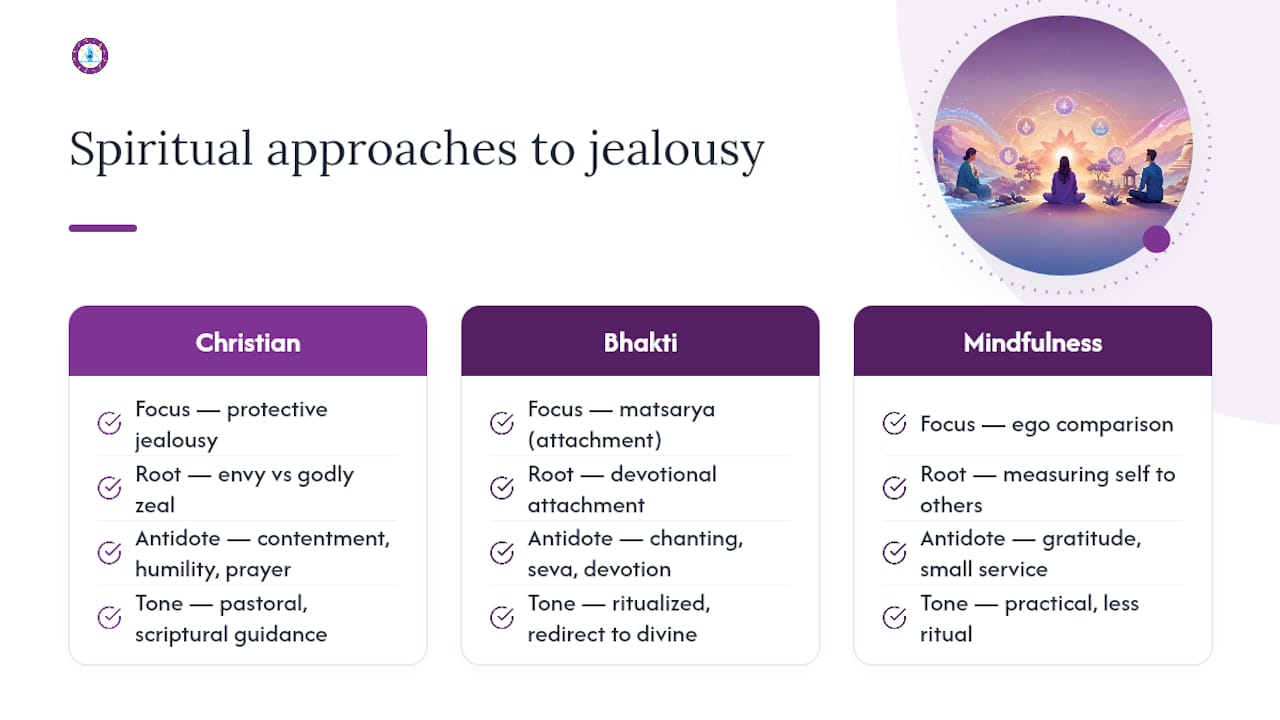
In Christian thought, jealousy and envy are often treated as related but separate. Envy wants what someone else has. Jealousy, by contrast, often works to protect something you already possess, whether that’s a relationship, a reputation, or a sense of standing. Scripture also draws a line between destructive jealousy, which is tied to being driven by the flesh, and what’s sometimes called godly jealousy, a protective zeal aimed at guarding something sacred. 1 Timothy 6:6 frames contentment as the antidote, positioning jealousy as a symptom of restlessness rather than an identity. Pastoral writers add that feeling jealous is common, not disqualifying, and they recommend humility and prayer as the practical corrective.
Bhakti tradition names this same energy matsarya, a form of asakli or attachment. Rather than treating it as a flaw to hide, Bhakti teachers frame jealousy as material to bring directly into devotional practice through chanting, seva (selfless service), and consciously redirecting attention toward divine abundance instead of scarcity.
Contemporary mystical and mindfulness-based views tend to describe jealousy as ego-driven comparison, the mind measuring your worth against someone else’s timeline. The prescription here leans on gratitude practice and small acts of service, less ritualized than Bhakti but aimed at the same outcome: loosening the grip of comparison.
Three traditions, three vocabularies, one shared instruction: don’t suppress it, work with it.
8 Spiritual Lessons Jealousy Can Teach You
Jealousy as a spiritual teacher offers specific, usable lessons if you’re willing to sit with the discomfort long enough to hear them.
- It exposes your real triggers. Notice exactly what set it off. A journaling prompt: “The moment jealousy hit, what had just happened?”
- It reveals a hidden desire. Underneath most jealousy is a want you haven’t named out loud. Try finishing this sentence: “What I really want is…”
- It locates a limiting belief. Jealousy often hides a quiet assumption like “there’s not enough success to go around.” Write the belief down and ask if it’s actually true.
- It calls you toward self-love. The sting usually means you’re measuring your worth by someone else’s results. A short practice: place a hand on your chest and say, “I am enough as I am, right now.”
- It’s proof abundance is possible. If someone else has what you want, that thing exists and is reachable, which is evidence, not a threat.
- It invites you to celebrate others. Bhakti teachers describe this as an active practice of rejoicing in another’s blessing while you keep working on your own path. Try sending a genuine, specific compliment to the person who triggered you.
- It prompts you to re-center. Jealousy pulls your attention outward; a few minutes of quiet breath work pulls it back to your own life and your own pace.
- It calls you to act. Sometimes jealousy is simply motivation wearing a disguise. Ask: “What’s one small step I could take today toward what I want?”
Each lesson works better as a practice than as a concept. Pick one, apply it the next time jealousy shows up, and notice what shifts.
Practical Spiritual Practices to Transform Jealousy
Insight without practice fades fast. These are concrete tools for turning a jealousy spike into forward motion.
- Name it and journal. As soon as you notice the feeling, write one sentence naming it: “I’m feeling jealous of ___ because ___.” Naming reduces its grip almost immediately.
- Use a short mantra or prayer. In Bhakti practice, chanting redirects attention away from comparison and toward the divine. A simple, repeatable line works even outside formal chanting, something like “May they be blessed, and may I trust my own path.” In a Christian frame, a brief prayer for contentment, drawn from the same spirit as 1 Timothy 6:6, serves a similar purpose.
- Practice seva or small acts of service. Doing something generous for someone else, especially the person triggering the jealousy, interrupts scarcity thinking fast. This is a core Bhakti prescription for transforming matsarya into humility.
- Try a release ritual. Light a candle, write the jealous thought on paper, and burn or tear it up as a symbolic letting go. Pair it with three slow breaths, in for four counts, hold for four, out for six.
- Build a gratitude counter-practice. For every jealous thought, name one thing in your own life you’re genuinely grateful for. This isn’t about denying the feeling, it’s about balancing the scale.
Pro Tip: Keep a small “jealousy log” for one week. Note the trigger, the underlying want, and one action you took. Patterns usually show up by day three, and they’re often more revealing than any single incident.
If jealousy keeps circling back to the same relationship or wound despite consistent practice, pairing spiritual tools with a licensed therapist or counselor isn’t a failure of faith. It’s often exactly what moves the work forward.
When Jealousy Crosses the Line Into Harm
Growth-oriented jealousy is uncomfortable but temporary. Harmful jealousy is different: it repeats, escalates, and starts controlling behavior rather than informing it.
Watch for these red flags:
- Obsessive thoughts about a partner or friend that don’t ease with reflection or time
- Controlling behavior: checking phones, restricting friendships, demanding constant reassurance
- Jealousy that escalates into anger, threats, or isolation tactics
If you recognize these patterns, boundary language matters. Try something direct and non-shaming: “I’ve noticed I’ve been asking to check your phone, and that’s not fair to either of us. Can we talk about what’s underneath it?” When jealousy is damaging a relationship, couples therapy, spiritual direction, or a licensed mental health professional can help in ways journaling alone can’t.
How a Live Spiritual Reading Can Help You Work Through Jealousy
Sometimes you need a fresh, outside perspective to see what’s underneath the jealousy. A live phone reading can map the feeling to a concrete next step, offer a short guided practice, or simply reflect back what you already sense but haven’t named.
Phone Psychic Readers provides real-time psychic consultations by phone, with hand-vetted psychics available 24/7. Readers go through a rigorous vetting process, and only a small percentage of applicants are accepted, which keeps the sessions grounded in real experience rather than guesswork. People consistently report feeling grounded and informed after a session, which speaks to how a short conversation can clarify what weeks of solo reflection sometimes can’t.
Before you call, get specific. Ask about the pattern behind the jealousy, not just the surface event. Bring one clear question, like whether a repeated trigger points to a relationship issue or an old wound. And keep the framing honest: a reading offers guidance and perspective, not a substitute for clinical mental health treatment when that’s genuinely what’s needed.
Beyond Christianity and Bhakti: Other Traditions’ Take on Jealousy
Buddhist teaching frames jealousy, or irshya, as one of several afflictive emotions rooted in attachment and a mistaken sense of separate self. The prescribed antidote is mudita, sympathetic joy, a deliberate practice of feeling genuine happiness for another person’s good fortune until it becomes automatic rather than forced.
Sufi mysticism treats jealousy as a veil over the heart, something that obscures the recognition that all blessings, yours and everyone else’s, flow from the same source. The practice here leans on dhikr, repeated remembrance, to dissolve the sense of separateness that makes comparison feel so urgent in the first place.
Indigenous and animist traditions often frame jealousy through a communal lens rather than an individual one. One person’s abundance is understood as strengthening the whole community, not diminishing anyone’s share. Ceremony and shared celebration, rather than private reflection, do the emotional work.
What unites these frameworks, alongside the Christian and Bhakti perspectives already covered, is a shared refusal to treat jealousy as purely personal pathology. Every tradition points to some form of connection, whether communal, devotional, or contemplative, as the corrective. The vocabulary changes. The direction doesn’t: move from separation toward connection, and jealousy loses much of its grip.
Jealousy and Shadow Work: What Your Envy Is Hiding
Shadow work, a concept rooted in Jungian psychology, deals with the parts of yourself you’ve disowned, suppressed, or refuse to acknowledge, and jealousy is one of the clearest windows into that hidden material.
Carl Jung argued that we often reject in others exactly what we haven’t accepted in ourselves. Applied to jealousy, this means the qualities that trigger you most sharply, someone’s confidence, their visibility, their ease with success, often mirror a capacity you possess but haven’t given yourself permission to express. The jealousy isn’t really about them. It’s about the gap between who you are and who you’ve allowed yourself to become.
Working with jealousy as shadow material starts with a blunt question: what does this person have that I secretly want for myself but believe I’m not allowed to have? The answer is rarely comfortable. It might be permission to take up space, to charge what your work is worth, or to receive recognition without deflecting it.
Shadow work doesn’t ask you to eliminate jealousy. It asks you to own the disowned desire underneath it, then decide what to do with that desire instead of projecting it onto someone else. That’s a slower, more honest process than simply trying to “think positive” your way past the feeling, and it tends to produce change that actually sticks.
Staying Grounded: Keeping the Growth After Jealousy Fades
The first time you successfully transform a jealousy spike into insight feels like a breakthrough. The real test is what happens the fifth time, and the fiftieth.
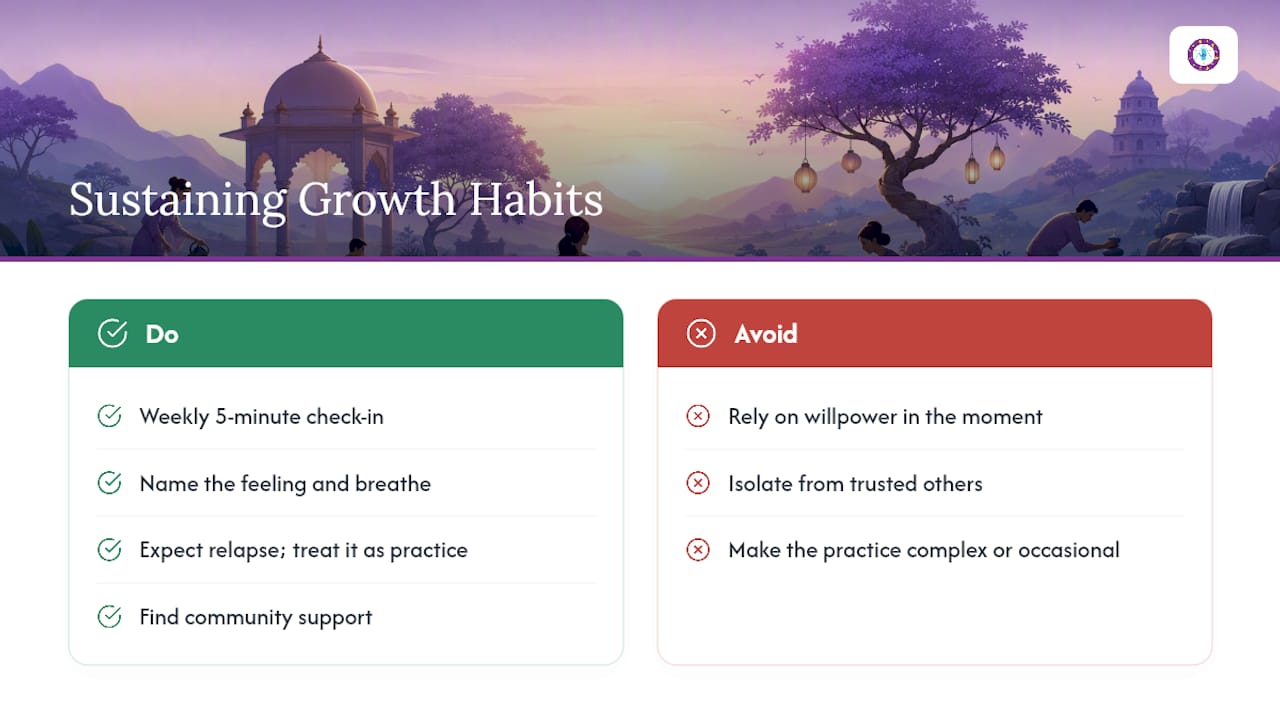
Long-term integration means building a repeatable rhythm rather than relying on willpower in the moment. A short weekly check-in works well: five minutes reviewing where jealousy showed up, what it revealed, and whether you followed through on the action it pointed toward. This turns a one-time insight into an ongoing practice rather than a memory you eventually stop applying.
It also helps to expect relapse without treating it as failure. Jealousy will resurface, often around the same themes, because old attachments rarely dissolve in a single sitting. What changes with practice is the gap between the trigger and your response. Where it once took days to metabolize a jealous reaction, over months it might take minutes.
Community support matters here too. Whether that’s a Bhakti sangha, a church small group, a therapy setting, or simply a trusted friend who knows your patterns, having someone reflect your growth back to you keeps the work honest. Isolation makes old patterns easier to slide back into.
Keep the practices simple enough to sustain: the naming, the breath, the gratitude, the small act of service. Complexity is the enemy of consistency, and consistency is what actually rewires a lifelong pattern into something workable.
A Note on Working With Jealousy Instead of Against It
Jealousy deserves to be treated as a teacher, not a source of shame. The most useful shift isn’t eliminating the feeling. It’s getting curious about it fast enough to catch what it’s actually pointing toward.
A simple personal practice worth borrowing: the next time jealousy flares, pause and name one honest sentence, “I want what they have because it would mean ___.” That single sentence usually cuts through weeks of vague discomfort. Try it once, and notice how much clearer the next step becomes.
Return to the practice often. Jealousy will keep showing up throughout life; what matters is whether you keep listening to it.
— Jason
A Practical Next Step When Jealousy Feels Stuck
Journaling and prayer resolve a lot of jealousy on their own, but sometimes the pattern keeps repeating no matter how much self-reflection you put into it. That’s usually the moment a live conversation with someone outside the situation helps more than another solo session with a notebook.

Connect with psychics available by phone at any time, without the wait or overhead of scheduling an in-person appointment. Readers go through a vetting process designed to keep sessions focused and grounded rather than vague. If your jealousy centers on a relationship, whether it’s a partner’s attention, a friend’s success, or trust that feels shaky over distance, a relationship psychic reading or relationship tarot reading can help name what’s underneath it and map out a concrete next step. If you’re unsure which type of session fits a bigger decision you’re facing, this guide to choosing the right reading walks through the options. Sessions are billed per minute; see the provider’s website for current rates and availability.
Sources
- Navigating jealousy on the spiritual journey — The Bhakti House
- 1 Timothy 6:6 context — BibleRef
- Spiritualdirection