
Horary Astrology Reading: Calculator or 24/7 Phone Reader?

A horary astrology reading gives you a focused answer to one specific question, drawn from a chart cast for the exact moment the question is asked, not the moment you were born. It works best for narrow, single-event questions with a real yes-or-no or a timing answer at stake, like “Will I get this job?” or “Is my lost ring in the house?” If your question is vague or open-ended, keep reading before you book anything.
Key Takeaways
- Horary astrology requires a precise, specific question with a clear outcome to produce reliable timing and verdicts, avoiding vagueness or broad inquiries.
- The method centers on the exact moment the question is understood, using traditional rules to assess radicality and identify relevant significators for a straightforward answer.
- Automated online calculators handle the technical process but cannot replace experienced judgment, especially in borderline or complex charts.
- Preparing a focused question with a single measurable outcome, the exact time, and relevant dates improves the accuracy of the reading, whether done professionally or via self-service tools.
- Horary is not suitable for broad life questions or personal long-term patterns; it excels at providing clear yes-or-no answers for specific events or conditions within a limited timeframe.
Table of Contents
- What Is Horary Astrology and Where It Comes From
- Which Questions Horary Suits (And Which It Doesn’t)
- How a Horary Reading Is Judged, Step By Step
- Online Calculators vs. Hiring a Professional Reader
- How to Prepare Your Question and What to Expect
- The Limits and Ethics of Horary Astrology
- Examples of Interpreting Typical Horary Questions
- Horary vs. Natal and Predictive Astrology
- A Practitioner’s View on Why Discipline Beats Convenience
- Get a Horary-Style Answer by Phone Today
- Selected Calculators and Guides to Learn More
- Sources
What Is Horary Astrology and Where It Comes From
Horary astrology answers a question by reading a chart for the moment someone truly understands what they are asking, not the moment of their birth. William Lilly laid out the rulebook for this practice in his 1647 text, Christian Astrology, which remains the reference point most serious practitioners still study today. Modern tools like Astrolium’s horary calculator and Astro-Seek’s free chart generator have automated much of Lilly’s method, but the underlying logic hasn’t changed in nearly four centuries.
There’s no birth chart involved here, which surprises a lot of newcomers. You don’t need your time of birth, your location at birth, or any natal data at all. The chart is built entirely around the question moment itself, treating that instant like a snapshot of the cosmos answering you directly.
A typical horary judgment comes back tight and specific: a clear verdict (yes, no, or a qualified maybe), any conditions attached to that verdict, and an estimated timing window. It’s less like a personality profile and more like a courtroom ruling. You get the outcome, the reasoning, and the timeline, but not a sprawling narrative about your life path.
Which Questions Horary Suits (And Which It Doesn’t)
Horary rewards specificity and punishes vagueness. The tighter your question, the more radicality and timing rules actually have something to grab onto.
Questions that work well:
- “Will I get the promotion I interviewed for last week?”
- “Should I sell my house this year, or wait until next spring?”
- “Is my ex going to reach out to me in the next month?”
- “Will this specific medical test come back clear?”
Questions that tend to fall apart under horary analysis:
- “What is my life purpose?”
- “Am I on the right path?”
- “What does the universe want for me?”
- “Will I ever be happy?”
The difference comes down to whether there’s a discrete, checkable outcome. Astrology timing predictions require a single event or condition to track. Open-ended existential questions have no clean resolution point, so there’s nothing for the chart’s significators to perfect toward.
If your question is too broad, narrow it. Instead of “Will I be successful in my career?” try “Will I be offered the position I applied for at [specific company] within the next two months?” That single change turns an unreadable chart into a workable one.
How a Horary Reading Is Judged, Step By Step
Judging a horary chart follows a sequence that hasn’t changed much since Lilly’s day, even though calculators now handle the arithmetic.
1. Stamp the moment. The astrologer notes the exact time and place where the question was fully understood, not asked casually or thought about days earlier. Location matters because house cusps shift with geography, and most horary practitioners still favor the Regiomontanus house system Lilly himself used.
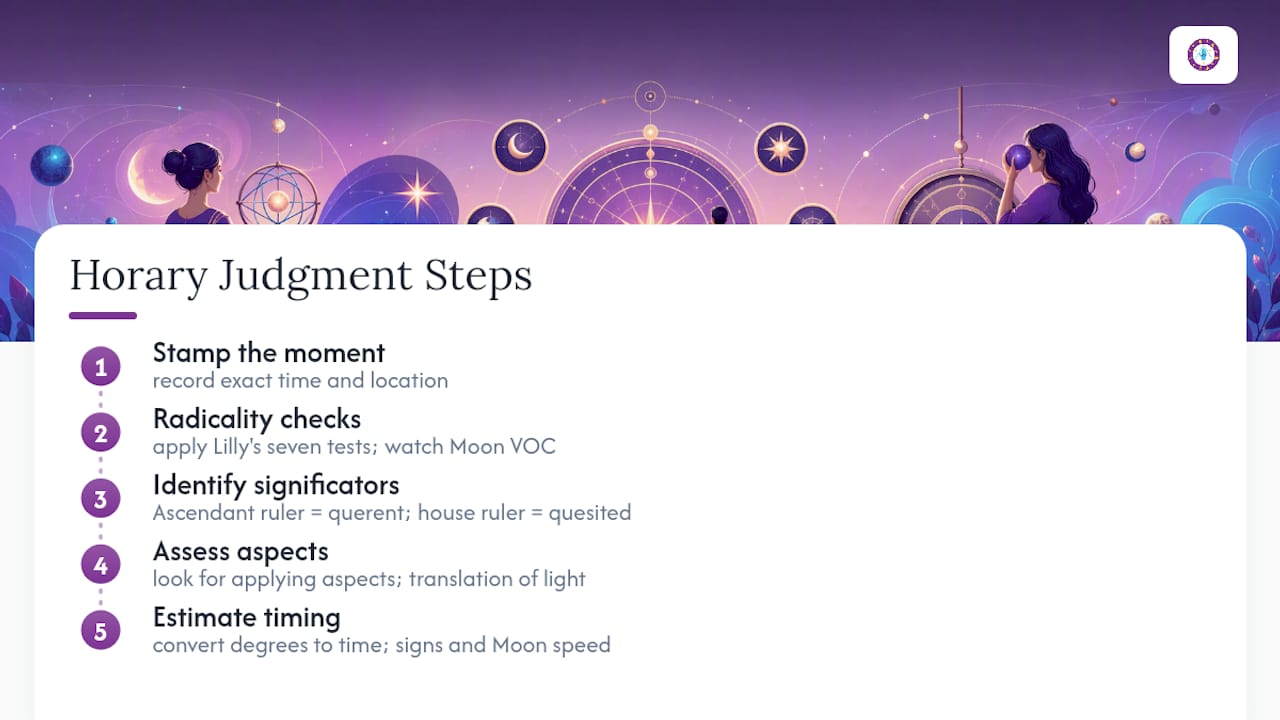
2. Run the radicality checks. Before any judgment happens, the astrologer checks whether the chart is even fit to answer. Lilly’s seven considerations before judgment cover things like whether the Ascendant sits at an unusable degree, whether Saturn afflicts the chart’s ruling planets, and whether the question came too early or too late relative to the moment of understanding. A practical summary of Lilly’s rules breaks these considerations down for modern readers. Two red flags come up constantly: the Moon Void of Course, where the Moon has finished all its aspects before changing signs, and the Moon or a significator caught via combusta, too close to the Sun to act freely. Lilly himself tended to flag these as cautions and proceed anyway. Later strict practitioners, notably John Frawley, argue a non-radical chart should simply be refused rather than pushed through. Most experienced readers lean toward the stricter approach as they gain practice.
3. Identify the significators. The Ascendant’s ruling planet (Lord 1) and the Moon typically represent the querent, the person asking. The “quesited,” the thing being asked about, gets represented by the ruler of a specific house depending on the topic. A job question routes through the 10th house. A relationship question often routes through the 7th. A home or family matter routes through the 4th.
4. Watch the aspects. Judgment hinges on whether the significators form an applying aspect, meaning they’re moving toward each other in degree, rather than a separating one. A clean applying aspect with no interference points toward a “yes.” Translation of light, where a third planet carries the connection between two significators that can’t reach each other directly, often signals the outcome will happen through an intermediary or a delay. Astrolium’s calculator runs a forward perfection search, typically scanning 30 days ahead to see whether the aspect actually perfects before it’s interrupted by a retrograde, a sign change, or another planet’s interference.
5. Estimate the timing. Degree counts between significators often convert to days, weeks, or months depending on the chart’s overall speed and the modality of the signs involved. Cardinal signs and a fast Moon tend toward quicker resolution. Fixed signs point toward a longer wait.
The most common mistakes aren’t technical. They’re procedural: re-casting the same question repeatedly until you get an answer you like (chart-hopping), stamping the wrong time because you asked the question days before you truly grasped what you needed to know, or skipping the radicality check entirely because the rest of the chart looks promising.
Pro Tip: Keep a running log of every horary question you ask, along with the judgment and the actual outcome. Over time, this log teaches you more about reading aspects and timing than any book, because you’re grading your own interpretation against reality.
Online Calculators vs. Hiring a Professional Reader
Both routes have a place, and the right one depends on how much is riding on the answer.
Calculators like Astro-Seek’s horary chart tool and Astrolium’s dedicated horary calculator handle the mechanical side fast:
- Time-stamping the chart to the second, with location built in
- Running Lilly’s seven considerations automatically and flagging Moon Void of Course or via combusta conditions
- Routing significators by question category
- Scanning forward for perfecting aspects within the standard window
What a calculator can’t do is judge a marginal chart with real discretion. A chart that’s borderline radical, or one where two aspects seem to contradict each other, needs a human who understands when strict refusal is the right call and when context justifies proceeding. That judgment call, along with the responsibility of telling a caller “this chart isn’t answerable, ask again differently,” is where an experienced reader earns their keep.
A sensible approach: run a quick exploratory check yourself on a free calculator when the stakes are low and the question is casual. For anything that actually matters, a legal decision, a relationship turning point, a major financial move, bring it to a professional who can read the gray areas.
How to Prepare Your Question and What to Expect
Getting a useful horary consultation starts before the reading, with how you frame the question itself.
Keep it to one focus. “Will I get this job, and should I also move to a new city?” is two questions wearing one trench coat. Split it. Name the subject clearly: not “will things get better,” but “will my current relationship recover in the next three months?” Avoid stacking multiple possible outcomes into a single question, since horary works best when there’s one clean condition to track.
What you tell the astrologer matters less than you’d expect. You don’t need your birth chart, your natal placements, or your life history. What matters is the question, phrased precisely, and the exact moment you settled on asking it.
Here’s a short checklist before your session or before you run a calculator yourself:
- Write your question down in one sentence, with a single measurable outcome.
- Note the exact time you finished forming the question, not when you first started wondering about it.
- Confirm your location, since house cusps shift by geography.
- Have any relevant dates or deadlines ready (a contract date, an event date) since timing estimates often reference them.
- Decide in advance how you’ll log the outcome so you can check the judgment later.
A finished session report typically includes a radicality verdict (was the chart fit to judge at all), the identified significators for you and the matter at hand, the applying or separating aspects between them, and an estimated timing window. Save that report. Comparing it against what actually happens is how you build real trust in the method over time.
The Limits and Ethics of Horary Astrology
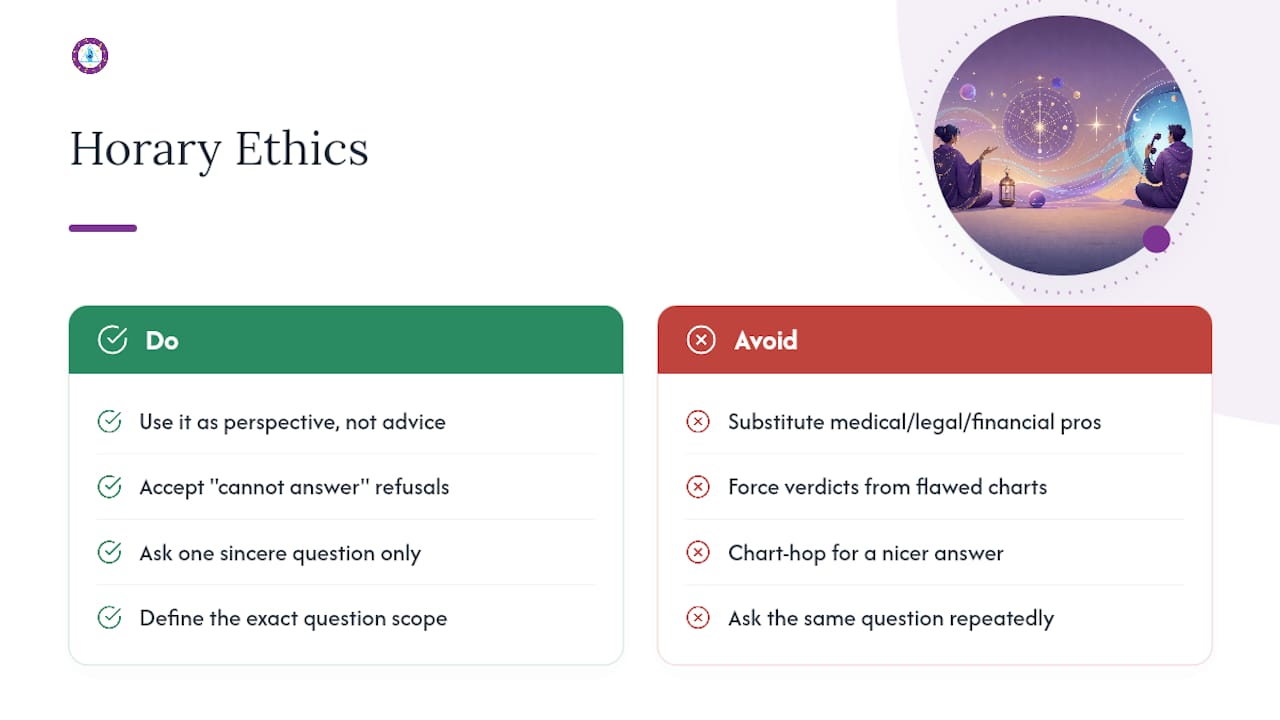
Horary astrology isn’t a substitute for medical, legal, or financial professionals, and any responsible reader will say so upfront. It offers a perspective on timing and likely outcomes, not a diagnosis or a binding decision.
The method also has a built-in honesty mechanism that a lot of newcomers don’t expect: sometimes the chart says “this question can’t be answered as asked.” A chart with multiple radicality failures, an unusable Ascendant degree, a significator that’s badly afflicted, isn’t a chart to force a verdict from. Disciplined practitioners treat refusal as part of the craft, not a failure of the tool.
Chart-hopping is the biggest ethical gray zone in horary practice. If you ask the same question five times in one week hoping for a more favorable chart, you’re not doing horary anymore. You’re shopping for an answer that flatters what you already want, and most experienced astrologers will tell you the first sincere question-moment is the only one that counts.
There’s also a question of scope. Horary answers the question you actually asked, not the deeper question you might not have realized you meant. “Will he call me?” and “Is this relationship healthy for me?” are different questions with potentially different charts, and a good reader will help you figure out which one you actually need answered before casting anything.
Examples of Interpreting Typical Horary Questions
A career question: “Will I get the job I interviewed for?” The 10th house rules career, so its ruling planet represents the position. If the querent’s significator (Lord 1 or the Moon) forms a clean applying aspect to the 10th house ruler before the Moon changes sign, that points toward a yes, often with a rough timing estimate based on the degrees separating them.
A lost object question: “Where is my missing watch?” These charts route through the house matching the object’s nature and often hinge on where the ruling planet of that house is positioned in the chart, sometimes literally suggesting a physical location (inside the home, at a workplace, with another person) based on which house the significator falls into.
A relationship question: “Will she reach out to me?” The 7th house typically governs the other person, and translation of light, where a third planet carries the connection between two significators, often shows up here. If Mercury or the Moon touches both parties’ rulers in sequence, that’s frequently read as a message or contact being the mechanism of the outcome, not a coincidence.
Each of these examples depends entirely on the exact question and moment, which is why two people asking what sounds like “the same question” can get genuinely different, and equally valid, answers.
Horary vs. Natal and Predictive Astrology
Natal astrology reads the chart of your birth moment to describe your temperament, tendencies, and long-arc life themes. It’s a portrait, built once and referenced for decades. Horary astrology interpretation works nothing like that. It ignores your birth chart entirely and instead reads the moment a specific question crystallizes, aiming for a single, time-bound answer rather than a lifelong sketch.
Predictive astrology, techniques like transits, progressions, or solar returns, forecasts themes and periods within an existing natal chart. It tells you “this is a season of change” or “expect financial pressure around this transit.” It doesn’t answer “will I get this specific job” the way horary does. Predictive work paints weather patterns. Horary chart analysis answers a single, dated question with a verdict attached.
The practical takeaway: if you want to understand your general nature or long-term patterns, natal astrology is the right tool. If you want forecasting across a season or year, predictive techniques fit better. If you have one specific, burning question that needs a yes, a no, or a timeframe, horary is built exactly for that job, and it’s usually faster to get a usable answer from it than from either of the other two methods.
A Practitioner’s View on Why Discipline Beats Convenience
The biggest misconception about horary astrology reading is that it’s just tarot with extra math. It isn’t. The radicality checks exist precisely to stop an astrologer from manufacturing a confident answer out of a chart that doesn’t actually support one, and that discipline is what separates horary from casual guesswork dressed up in planetary language.
What gets underestimated is how much the refusal to judge matters. A reader who tells you “this chart isn’t radical, ask me again once you’ve truly settled on your question” is doing better work than one who forces a verdict out of a shaky chart just to give you something. That’s not caution for its own sake. It’s the same quality control that separates a careful mechanic from one who guesses at the diagnosis to get you out the door faster.
Outcome-logging is the other piece nobody talks about enough. A vetted reader who tracks how their past judgments actually played out, and who works within a marketplace that holds readers accountable to real results, brings something a one-off calculator run simply can’t: a track record. That accountability is worth paying attention to when you’re deciding who answers your next real question.
— Jason
Get a Horary-Style Answer by Phone Today
If you’d rather talk through your question with someone who can weigh the nuance a calculator misses, Phonepsychicreaders offers a faster route than researching house rulers at midnight. Sessions run 24/7 so a pressing question about a job, a relationship, or a decision doesn’t have to wait until morning.

A typical phone session works a lot like a horary consultation: you bring one focused question, the reader tunes into the specifics of your situation, and you walk away with a direct answer instead of a vague impression. You won’t need to prepare a birth chart or explain your full history. State your question clearly, the same way you would before running a calculator, and let the reader work from there. People often feel grounded and clear-headed after a session, which matters most when the question has been sitting heavy for days.
Ready to get an answer to the question that’s actually on your mind? Book a reading and connect with a vetted reader now.
Selected Calculators and Guides to Learn More
For hands-on practice, Astrolium’s horary calculator automates radicality checks and perfection searches. Astro-Seek’s chart calculator generates a free traditional horary wheel. For the classical method itself, William Lilly’s Christian Astrology remains the foundational text behind nearly every modern technique described here.
Sources
- Horary Astrology Calculator — Astrolium
- Horary Astrology Chart Calculator — Astro-Seek
- William Lilly Horary: Practical Rules for Judgment — TheAstroKind