St. John of the Cross to Clinical Help: Dark Night of the Soul

The dark night of the soul is a period of spiritual darkness and apparent emptiness that St. John of the Cross first described as passive purification on the way to union with God, a term modern usage has stretched to cover any devastating spiritual or existential crisis. It can be genuinely transformative, but it can also mask clinical depression, so if you’re having thoughts of suicide or can’t function day to day, that overlap needs a clinician’s attention first. The sections ahead walk through where the phrase comes from, how to recognize it, and what actually helps you move through it.
Key Takeaways
- The original “dark night of the soul” describes a passive spiritual purification leading to union with God, often lasting years and involving deep inner stripping.
- Modern usage broadens the term to include any severe existential crisis, but not every prolonged suffering warrants a spiritual interpretation, especially if clinical symptoms like suicidality are present.
- Recognizable signs involve spiritual dryness, emotional numbness, loss of meaning, and disorientation, often triggered by grief, loss, or midlife transitions; serious symptoms require immediate clinical attention.
- Moving through the dark night benefits from surrender, slow contemplative practices, and community support, while overactivity or forcing effort tends to prolong the experience.
- Always rule out treatable depression or mental health crises before attributing the darkness solely to spiritual growth or purification.
Table of Contents
- Where Does “Dark Night of the Soul” Come From?
- How Modern Usage Differs From the Original Meaning
- What Are the Signs and Triggers of a Dark Night?
- What Are the Interior Stages of a Dark Night?
- How Do You Move Through a Dark Night of the Soul?
- What Do the Primary Sources and Practitioners Say?
- A Practitioner’s Honest Reflection
- When a Phone Reading Can Offer Perspective
- Where to Go Deeper
- Sources
Where Does “Dark Night of the Soul” Come From?
St. John of the Cross, a 16th-century Spanish Carmelite friar, coined “Noche Oscura” to describe a specific stage in the soul’s journey toward union with God. He wasn’t writing a self-help pamphlet. He was writing poetry and theology for people already committed to a contemplative life, and his framework only makes sense inside that context.
The poem itself runs eight stanzas, and it reads more like a love story than a treatise on suffering. A soul slips out of a sleeping house at night, guided by nothing but an inner light, to meet a beloved. The darkness in the poem isn’t punishment. It’s cover. It’s what lets the soul move past the noise of the senses and the intellect toward something it couldn’t reach in daylight. You can read the full poem text at Poetry Foundation, and the imagery there, the secret ladder, the extinguished lamp, the union at dawn, still shapes almost every contemporary description of the experience.
John followed the poem with a prose commentary, sometimes called the Declaración, that unpacks what the images mean theologically. This is where the concept gets its structure. He distinguishes between active purgation, the disciplines a person deliberately takes on like fasting or prayer, and passive purgation, the deeper stripping away that God initiates and the person can’t control or hurry. The treatise, available through the Christian Classics Ethereal Library, frames this passive night as necessary precisely because it reaches parts of a person that willpower can’t touch. Self-denial gets you partway. It cannot get you all the way there.
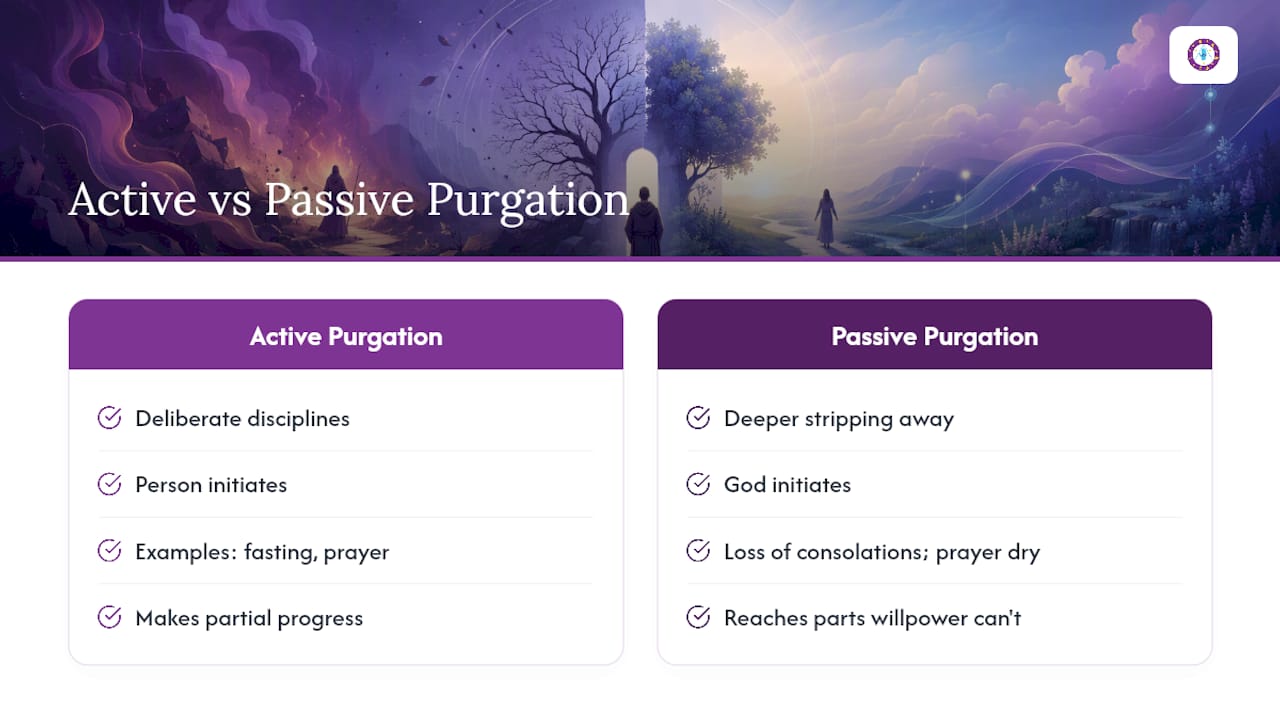
The “darkness” in John’s system does double duty. Philosophically, it points to the unknowability of God, the sense that any concept the mind forms is too small for what it’s reaching toward. Practically, it describes the felt experience of losing every consolation you used to rely on: prayer goes dry, meaning drains out of practices that once felt alive, and you’re left without the emotional feedback that told you God, or purpose, or meaning was still there. According to Wikipedia’s overview of the term, this passive purification sits within a larger mystical sequence of active purgation, illumination, and union, and it’s specifically that middle collapse, not general hardship, that John is describing.
History gives us long, documented cases of this. St. Paul of the Cross, the 18th-century founder of the Passionists, wrote of decades of interior desolation even while founding a religious order and directing others spiritually. Mother Teresa’s private letters, made public after her death, revealed nearly fifty years of what she called interior darkness and a felt absence of God’s presence, alongside decades of visible, effective ministry. Both cases matter for the same reason: neither collapse stopped the person’s capacity to function or serve. The darkness and the fruit ran side by side.
How Modern Usage Differs From the Original Meaning
Somewhere in the last century, “dark night of the soul” slipped out of monasteries and into everyday language, and something got lost in the move. John was describing a specific stage within a committed contemplative practice, aimed at union with God. Today the phrase gets applied to almost any severe identity crisis, existential despair, or life-shattering loss, religious or not.
That expansion isn’t necessarily a corruption. Losing your sense of meaning after a divorce, a diagnosis, or a career collapse can produce something structurally similar to what John described: the old frameworks stop working, and nothing new has arrived yet to replace them. The Wikipedia entry on the term notes explicitly that modern usage has broadened well beyond the mystical-purificatory process John had in mind, into a general label for extreme spiritual or existential crisis.
Contemporary essays tend to split into two camps on what to do with that broadened definition. One camp treats the dark night as initiation, a threshold experience that, if you can stay with it, delivers you somewhere more honest and alive than where you started. The Kosmos Journal essay on the discovery of meaning takes this stance, describing the experience as life-shaking but ultimately meaning-revealing when a person can hold it with enough support and reflective practice. The other camp is more cautious, warning that calling every hard season a “dark night” risks turning a clinical or medical problem into a spiritual badge of honor.
Both camps are right about something. Suffering can crack a person open in ways that produce real depth and clarity afterward. But suffering by itself doesn’t guarantee transformation. Plenty of people go through years of pain and come out more bitter, more closed, more afraid, not less. What separates a genuinely transformative dark night from a period of unrelenting misery usually comes down to whether the person has support, safety, and some capacity to reflect, not whether the suffering was intense enough.
This is where romanticizing gets dangerous. A person cycling through major depressive episodes, unable to get out of bed, losing weight, withdrawing from everyone they love, is not automatically undergoing mystical purification. They may be. But treating a treatable mood disorder as a spiritual crisis to be endured rather than a medical condition to be treated can cost someone years, or worse. Practitioner essays increasingly stress this distinction, and rightly so: the label “dark night” should describe an experience, not excuse avoiding care that could actually help.
What Are the Signs and Triggers of a Dark Night?
A dark night rarely announces itself. It tends to creep in as a slow draining of color from things that used to feel vivid, and most people don’t recognize what’s happening until they’re already deep inside it.
Common signs include:
- A pervasive loss of meaning in activities, relationships, or beliefs that once felt central to your identity
- Spiritual dryness: prayer, meditation, or ritual practices feel mechanical or entirely empty, even if you keep doing them
- Emotional numbness or flatness rather than acute sadness, a kind of interior fog rather than a storm
- Diminished capacity for pleasure in things you used to enjoy without effort
- Persistent existential questioning: what’s the point, who am I without this, was any of it real
- A sense of disorientation, as if the map you used to navigate life no longer matches the territory
Certain events tend to trigger this state more than others. Bereavement is one of the most common, especially when the loss also takes away a role or identity, not just a person. The end of a long relationship or marriage does something similar. Career collapse, whether through job loss, burnout, or realizing a life’s work no longer feels meaningful, shows up constantly in practitioner accounts. Sometimes there’s no single event at all: a slow erosion of faith, purpose, or vitality over years, until one day you notice the foundation is gone. Midlife transitions carry their own particular flavor of this, when the goals that organized decades of effort get achieved, or abandoned, and leave a vacuum behind.
Not every difficult season is a dark night, and not every dark night is purely spiritual. Certain signs mean you need clinical evaluation now, not later:
- Active suicidal ideation or thoughts of self-harm
- Inability to function, meaning you can’t work, eat, sleep, or care for yourself for an extended stretch
- Psychotic symptoms, such as hallucinations or delusions
- Symptoms consistent with a major depressive episode that persist for weeks without any variation
Practitioner-written guides that catalog these symptoms consistently pair the list with a caution: distinguishing spiritual crisis from clinical depression is not something to guess at alone. A WikiHow guide on dark night symptoms makes this same point, pairing signs and coping strategies with a clear recommendation to involve a therapist when the picture includes any of the red flags above.
What Are the Interior Stages of a Dark Night?
There’s no fixed timeline here, and treating the dark night like a project with milestones tends to backfire. Still, most first-person accounts and practitioner narratives describe a rough sequence of interior movements, even if the order isn’t linear and stages double back on themselves.
- Dissolution of old frameworks. The beliefs, roles, or certainties that used to organize your sense of self start to crack. This is often the most disorienting part, because you haven’t yet lost the old identity, you’re just watching it stop working in real time.
- Descent and emptiness. Once the old structure genuinely falls away, there’s frequently a period of felt absence rather than active pain, a flatness where meaning used to be. This is what John of the Cross called the passive purification: not something you’re doing to yourself, but something happening to you that you can’t force or rush.
- Subtle reconfiguration and slow emergence. New priorities, values, or capacities begin to surface, usually quietly and well before you’d call yourself “through it.” Emergence tends to arrive gradually, often noticed only in hindsight.
The word “purification” can sound harsh in plain modern language, but it’s really describing a stripping away of attachments and false certainties that were never load-bearing to begin with. John’s related term, sometimes translated as “unselfing,” points at the same idea: the process wears down the ego’s grip on control, which is uncomfortable precisely because control felt like safety.
Duration varies enormously, and that variability is the point, not an exception to it. Some people move through a dark night in weeks. Others live inside one for years. The historical record backs this up starkly: St. Paul of the Cross and Mother Teresa both described decades of interior darkness, not a passing rough patch. If you’re three months in and still in the descent phase, that doesn’t mean something’s wrong with how you’re doing it. Patience isn’t passive resignation here. It’s closer to the difference between forcing a plant to bloom and giving it the right conditions and trusting the timeline you can’t see.
How Do You Move Through a Dark Night of the Soul?
The instinct to fix a dark night fast is completely understandable, and it’s also usually the thing that prolongs it. Practitioners across both contemplative and clinical traditions converge on the same observation: overactivity, forcing a return to “normal,” and white-knuckling your way back to feeling fine again tend to keep the process going longer than surrender-oriented approaches do. That doesn’t mean giving up. It means loosening your grip on the outcome while still showing up for the practices that support you.
Spiritual practices worth trying:
- Contemplative attention: sitting with the emptiness rather than immediately trying to interpret or fix it
- Slow journaling, using open prompts like “what is this experience asking me to release?” rather than goal-oriented ones
- Embodied routines that don’t require motivation or belief to work: consistent sleep, regular movement, time outdoors
- A small ritual to mark the transition, lighting a candle, a walk you take at the same time each week, something that acknowledges you’re in a passage rather than stuck
Clinical and medical guidance to take seriously:
- Screening for depression is not optional if symptoms have lasted more than two weeks with no variation in mood
- Contact a clinician if you notice appetite or sleep changes, loss of function at work or home, or a persistent sense of hopelessness
- If you’re having thoughts of suicide or are in crisis, call or text 988 (the Suicide and Crisis Lifeline in the United States) immediately
- Trauma-informed therapy can help when the dark night was triggered by loss, abuse, or a major life rupture, since standard talk therapy sometimes misses how trauma shows up in the body
Integration practices for the emergence phase:
- Small experiments: low-stakes ways of testing new interests or values before committing to big changes
- Community, even a small one, matters more than most people expect during isolation-heavy stretches
- Meaning-making through creative expression, writing, art, or simply naming what the experience taught you, tends to consolidate whatever shift has happened
Pro Tip: If you notice yourself scheduling your way out of the dark night, back to back plans, constant busyness, forcing positivity, treat that as a signal to slow down rather than speed up. Surrender-oriented practices aren’t about giving up on your life. They’re about stopping the fight against what’s already happening so the actual work of integration can catch up.
Clinical and contemplative voices increasingly agree on one non-negotiable step before anything else: rule out treatable depression, active suicidality, or mood instability first, then interpret what remains through whatever spiritual, therapeutic, or reflective lens fits your situation. Skipping that order is where people get hurt.

What Do the Primary Sources and Practitioners Say?
The clearest starting points remain John of the Cross’s own writing: the poem itself at Poetry Foundation for the imagery, and the treatise at CCEL for the theological structure behind it. Contemporary practitioners, including the essayists at Kosmos Journal, extend that framework into secular and interfaith contexts, always with the same caveat: check for treatable illness before assuming the darkness is purely spiritual.
A Practitioner’s Honest Reflection
What actually helps, more than any single technique, is slowing down enough to stop fighting the process and letting quiet practices, honest community, and a willingness to get screened for depression when something feels clinically off do their work in parallel. None of that makes the descent shorter by force. It makes it survivable, and eventually, workable. The practical steps outlined above, rest, ritual, honest conversation, professional screening when warranted, aren’t consolation prizes. They’re the actual mechanism by which people come out the other side more whole than when they went in.
— Jason
When a Phone Reading Can Offer Perspective
A dark night rarely resolves in a single conversation, but sometimes what you need most is a real-time voice that can help you see the shape of what you’re going through right now. Phonepsychicreaders connects you with hand-vetted psychics, available 24/7, who focus specifically on spiritual questions like meaning, direction, and what a particular season of darkness might be asking of you.

Every reader on the platform goes through a rigorous vetting process before they’re accepted, so you’re not gambling on a stranger’s guesswork when you’re already feeling unmoored. A session won’t replace therapy, and it’s not built to handle a crisis: if you’re having thoughts of suicide or can’t function, call 988 or reach a licensed clinician first. But for the ordinary ache of not knowing what your dark night is pointing toward, a spiritual guidance reading by phone offers a grounded, tailored perspective when you need it, priced per minute with a first-time caller discount so you can try a short session before committing to more.
Where to Go Deeper
- The poem itself, at Poetry Foundation: the original imagery every later description draws from.
- John of the Cross’s treatise, via CCEL: the full theological commentary behind the poem’s stanzas.
- The Wikipedia overview: a concise history of the term’s origin and its broadened modern usage.
- Kosmos Journal’s essay on meaning-making: a practitioner’s take on the dark night as a threshold worth staying with.
- Annie Wright’s clinical-practitioner guide: a sober framework for screening out treatable depression before assuming purely spiritual causes.
Sources
- Dark Night of the Soul — Wikipedia
- The Dark Night of the Soul — Poetry Foundation
- Dark Night — Christian Classics Ethereal Library (John of the Cross)
- A Dark Night of the Soul and the Discovery of Meaning — Kosmos Journal