
Clairvoyant vs Clairaudient: How They Differ and How to Tell
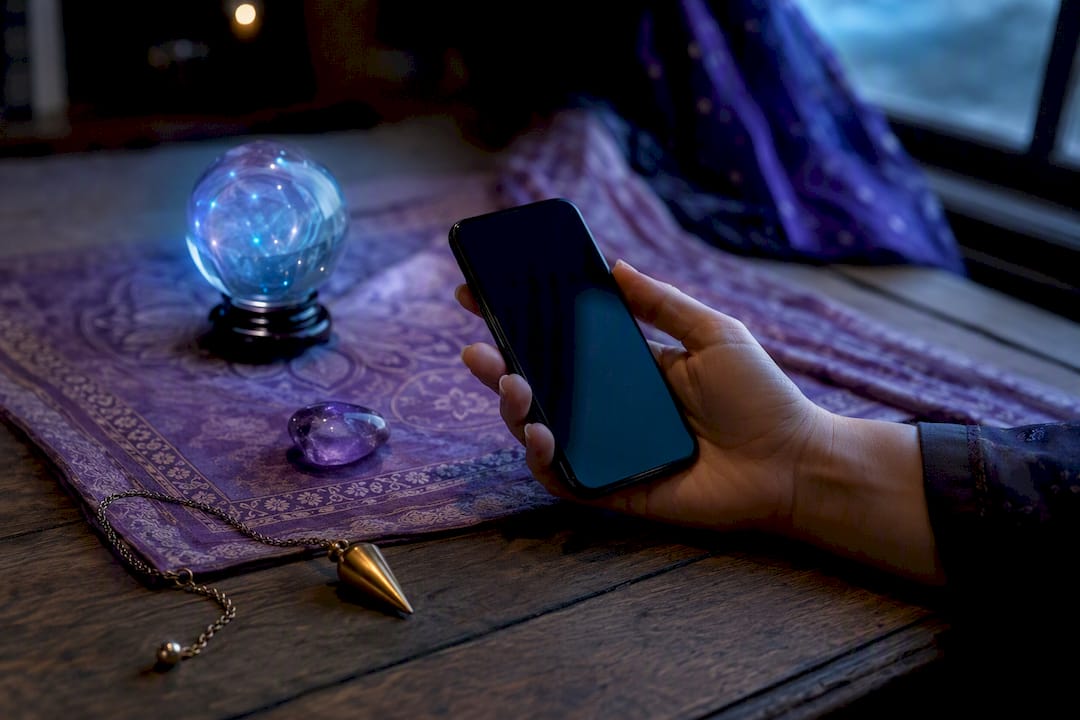
A clairvoyant experience arrives through pictures. A clairaudient one arrives through words. If your impressions show up as mental images, symbols, or flashes of a scene, you’re leaning clairvoyant; if they show up as an inner voice, a phrase, or a tone you “just hear,” you’re leaning clairaudient. Most people notice a blend of both, and that overlap is normal.
Key Takeaways
- Confirm whether you overwhelmingly experience mental images or clear words first, as this indicates whether you lean clairvoyant or clairaudient.
- Keep detailed records of your impressions over time, including timing and content, to identify which channel is dominant and how it varies with stress or sleep.
- Scientific testing has not proven repeatable clairvoyant or clairaudient phenomena, so focus on tracking specific, time-stamped impressions rather than vague successes.
- During phone readings, clairvoyance emerges as scene descriptions while clairaudience delivers brief, neutral phrases, and asking directly can help identify a reader’s channel.
- Your dominant psychic channel may shift weekly, so prioritizing objective, testable impressions over dramatic visions improves accuracy and self-awareness.
Table of Contents
- Clairvoyant vs Clairaudient: A Side-by-Side Look
- What Clairvoyant Experiences Feel Like
- What Clairaudient Experiences Feel Like
- How to Identify Your Dominant Psychic Channel
- Common Misconceptions and What Science Actually Says
- How These Abilities Show Up in a Phone Reading
- The Real Difference Nobody Talks About
- Sources
Clairvoyant vs Clairaudient: A Side-by-Side Look
The easiest way to tell these two apart is to ask what shows up first when your intuition speaks to you: a picture or a sentence. Clairvoyance is often described as “clear seeing,” while clairaudience is “clear hearing,” a distinction Learn Religions lays out clearly in its rundown of the psychic senses.
Here’s how the two channels typically compare:
- Sensory channel: Clairvoyant impressions arrive as images, symbols, or visual scenes; clairaudient impressions arrive as words, phrases, or tones.
- Common triggers: Clairvoyance often surfaces during meditation, dreaming, or staring at a blank wall; clairaudience often surfaces during quiet moments, prayer, or right before sleep.
- Message shape: A clairvoyant hit might look like “a closed door” or “a red car”; a clairaudient hit might sound like “wait” or “not yet.”
- How it feels: Clairvoyance feels like watching a short film; clairaudience feels like someone leaning close to say one sentence.
- Overlap: Many people register a picture and a phrase together, which is exactly what practitioner sources mean when they talk about a “dominant channel” rather than a fixed label.
If images dominate your recall, you’re likely working with clairvoyant abilities. If sentences and single words stick with you instead, you’re leaning clairaudient.
What Clairvoyant Experiences Feel Like
Clairvoyance covers more ground than a single mental picture. The Encyclopedia Britannica describes it as perceiving images or visions beyond normal sensory contact, a category that has historically included precognition, retrocognition, and remote viewing, even though none of it has held up under controlled testing.
In practice, clairvoyant abilities show up in several forms:
- Flash images — a brief mental picture, often a single object or face, that appears uninvited.
- Symbolic visions — a scene that needs translation, like seeing a locked gate to represent a stalled decision.
- Peripheral impressions — movement or light caught at the edge of vision that has no physical source.
- Vivid or lucid dreams — dream content that feels unusually sharp or repeats across nights.
- Third-eye pressure — a subtle sensation between the brows some describe as a “pulling” feeling right before an image forms.
A common vignette: someone thinking about a job offer suddenly pictures a specific building lobby, then finds themselves standing in that exact lobby weeks later for an interview. That’s the pattern clairvoyant abilities tend to follow, images first, meaning second.
Pro Tip: Write down the image the moment it appears, before you interpret it. Interpreting on the spot is where wishful thinking sneaks in and quietly rewrites what you actually saw.

What Clairaudient Experiences Feel Like
Clairaudient characteristics tend to be quieter and shorter than most people expect. Practitioner writing describes clairaudience as hearing calm, brief, directive messages rather than a running conversation, a point mindbodygreen makes well in its breakdown of the four intuitive channels.
Signs of a clairaudient impression include:
- A single word or short phrase that surfaces mid-thought, unconnected to what you were just thinking about.
- A tone or faint ringing that arrives right before or after an insight.
- Hearing a name in a dream that later turns out to matter.
- A calm, neutral “voice” that gives direction rather than opinion, such as “call her today.”
One typical example: you’re debating whether to text an old friend, and the phrase “not yet” surfaces on its own. That’s a smaller, gentler signal than the sustained, often distressing voices linked to auditory hallucinations, and Intuitive Souls draws that line explicitly, noting that clairaudience usually feels brief and neutral rather than intrusive or commanding.
Pro Tip: Compare the tone against your normal internal chatter. Ordinary thoughts tend to argue with themselves; clairaudient impressions tend to state something once and stop.

How to Identify Your Dominant Psychic Channel
You don’t need special equipment to figure out which clair you lean on. You need a notebook and a few honest minutes.
- The first-impression test. Ask yourself a simple, answerable question (“What does tomorrow look like?”) and note whether a picture or a phrase arrives first.
- The two-minute quiet test. Sit in silence for two minutes with no phone, and record whatever surfaces, image or words, without editing it.
- The dream recall check. Keep paper by your bed for a week and note whether your dream memories lean visual (scenes, faces) or auditory (names, spoken lines).
- The prediction test. Make one small, checkable guess about your day, log the time, and verify it later that evening.
Time-stamping every entry matters more than the exercises themselves, since patterns only become visible once you can compare dozens of entries side by side rather than trusting memory alone. If any of these impressions feel intrusive, distressing, or disruptive to daily life rather than brief and neutral, that’s a signal to talk with a licensed mental health professional, not just journal through it.
Common Misconceptions and What Science Actually Says
No controlled study has ever demonstrated repeatable clairvoyance or clairaudience under conditions that rule out chance, selective memory, or coincidence. The Skeptical Dictionary’s summary of decades of parapsychology testing is blunt: apparent hits get remembered, misses get forgotten, and that asymmetry alone can manufacture the illusion of accuracy.
Mainstream scientific and psychological communities generally treat these experiences as products of confirmation bias, subjective validation, or ordinary physiological phenomena, not paranormal perception, even though public belief in clairvoyance still runs between roughly 25% and 40% depending on the poll.
That gap between belief and evidence, as Wikipedia’s overview notes, isn’t really a mystery. People remember the one accurate detail from a reading and quietly discard the details that missed. The fix is procedural, not philosophical: log impressions before you know the outcome, favor claims specific enough to be wrong, and treat any reading, yours or someone else’s, as a starting point for reflection rather than a verified fact.
How These Abilities Show Up in a Phone Reading
On a live call, clairvoyant impressions usually surface as the psychic describing a scene, a color, or a symbol tied to your situation, while clairaudient impressions come through as a specific phrase or word the reader says they’re “hearing” about you. Neither is better; they’re just different instruments picking up the same signal.
Phonepsychicreaders vets its readers closely, accepting only a small share of applicants, so the person on the line has practiced distinguishing a genuine impression from a guess. If you want to see which channel a reader leans on, ask directly (“are you seeing something or hearing something?”) and note how specific the answer is. A clairvoyant reading is available 24/7 if you want to test your own impressions against a live reader’s.
The Real Difference Nobody Talks About
Most articles on this topic treat clairvoyant and clairaudient like fixed personality types, as if you’re permanently “a seer” or “a hearer.” That framing oversells the certainty. The more useful question isn’t which label fits you, it’s which channel is loudest this week, because stress, sleep, and attention all shift which sense comes through clearest.
The conventional advice to “meditate until your gift reveals itself” also skips the boring part that actually works: writing things down before you know if you were right. Skip the journal, and you’ll always remember the one hit and forget the four misses, which is exactly how the 25 to 40 percent belief gap keeps itself alive.
If you’re genuinely curious rather than looking for confirmation, prioritize testable, time-stamped impressions over dramatic ones. A quiet “not yet” that turns out correct is worth more than a vivid vision that means nothing specific. And if you want a second set of trained ears or eyes on your own impressions, a psychic reading by phone gives you a low-pressure way to compare notes with someone who reads both channels for a living.
— Jason
Sources
- Clairvoyance | Encyclopedia Britannica
- Clairvoyance — Wikipedia
- Meaning of Clairaudience, Clairvoyance, Claircognizant — Learn Religions
- The 4 clairs of intuition & how to tap into each — mindbodygreen
- Clairaudience: What It Actually Feels Like — Intuitive Souls
Recommended
- Clairvoyant Reading by Phone | Live Clairvoyants 24/7 from $1/Min
- Clairvoyant Psychic Reading in North Hollywood, CA | Live by Phone 24/7 from $1/Min
- Clairvoyant Psychic Reading in Burbank, CA | Live by Phone 24/7 from $1/Min
- Clairvoyant Psychic Reading in Glendale, CA | Live by Phone 24/7 from $1/Min