
Beginners: Use the 100 Mile Rule to Read Astrocartography Maps

An astrocartography reading shows where your planets fall on the four angles of a birth chart projected across a world map, marking the places where certain life energies concentrate. The calculation itself is exact. The interpretation depends on you. Your best first step is simple: generate your map, pick one real place you’re curious about, and read it as planet plus angle plus distance.
Key Takeaways
- Proximity to a planetary line generally influences its strength more than the planet’s type, with effects tapering off beyond 300 miles.
- The angle a planet touches determines which life area it activates, making it crucial to prioritize angles like MC for career or DC for relationships in decision-making.
- Accurate birthplace data and testing with varied birth times improve the reliability of line interpretation, especially for sensitive angles like the Ascendant or Midheaven.
- Lines that cross or appear near key locations amplify the planet’s influence, especially at power spots, which can significantly reinforce or challenge your expectations.
- Astrocartography should be combined with practical factors such as cost, language, climate, and personal goals; charts alone cannot fully guide major life choices.
Table of Contents
- What Is an Astrocartography Reading, and How Do You Generate One?
- The Four Angles: Why Where Matters More Than What
- What Each Planetary Line Means in Plain English
- How Far Does a Line’s Influence Actually Reach?
- How to Read Your Astrocartography Map, One Place at a Time
- Advanced Layers: Parans, Relocated Charts, and Realistic Cautions
- Using Astrocartography in Real Consultations
- How to Get a Personalized Astrocartography Reading by Phone
- Where to Verify the Technical Details
- Sources
- FAQ
What Is an Astrocartography Reading, and How Do You Generate One?
Every astrocartography reading starts with the same three inputs: your birth date, your exact birth time, and your birthplace. Skip the birth time and your Midheaven and Ascendant lines shift, sometimes by hundreds of miles, so if you genuinely don’t know your birth time, treat any reading as a rough sketch rather than a fixed map. Many hospitals and county records offices still have birth certificates with recorded times, and it’s worth the request before you trust a chart built on guesswork.
Locational astrology calculators typically run on Swiss Ephemeris data, which is the same astronomical standard most professional astrologers rely on for accuracy. Providers openly note that the math is precise while the meaning drawn from it stays open to interpretation, so don’t treat a calculator’s output as a verdict.
When comparing tools, look for:
- A city gazetteer so you can search any town, not just capitals
- Distance or orb readouts showing how close a line falls to a specific spot
- Power-spot detection that flags where multiple lines cross
- City-report or compare features, since some calculators now score locations on a 0 to 100 scale across categories like career or love
Before you trust any output, check that your birthplace anchor is correct and test what happens if you nudge your birth time by 15 minutes. If the lines barely move, your data is solid.
The Four Angles: Why Where Matters More Than What
A planet on your map means little without knowing which angle it touches. The angle tells you which part of life gets activated; the planet tells you how. This pairing is the entire grammar of an astrocartography chart interpretation, and skipping it is the most common beginner mistake.
The four angles, in plain terms:
- Ascendant (AC): Identity, first impressions, how you show up physically and socially in a place
- Descendant (DC): Partnerships, marriage, close one-on-one relationships
- Midheaven (MC): Career, public reputation, ambition, visibility
- Imum Coeli (IC): Home, family, roots, private emotional life
A Venus line crossing your Descendant suggests a place where romantic connection comes easily. That same Venus touching your Midheaven instead points toward a career built on beauty, art, or diplomacy rather than a relationship. The angle carries as much weight as the planet itself, which is why two people with the same planetary line can have completely different experiences of a city.
If you’re chasing a specific goal, prioritize accordingly: career moves should lean on MC lines, relationship questions on DC lines, and any decision about putting down roots on the IC.
Pro Tip: When a location shows more than one strong angle, note which one aligns with why you’re actually considering the move. A city might be excellent for love and mediocre for your career, and that trade-off is worth naming honestly before you pack a bag.
What Each Planetary Line Means in Plain English
Once you know the angle, the planet fills in the flavor. Here’s a working shorthand for reading any line on your astrology travel maps:
- Sun: Vitality, confidence, recognition, feeling seen
- Moon: Emotional comfort, intuition, domestic rhythm, mood
- Mercury: Communication, learning, networking, mental stimulation
- Venus: Romance, aesthetics, social ease, pleasure
- Mars: Drive, competition, physical energy, conflict
- Jupiter: Expansion, luck, opportunity, growth
- Saturn: Discipline, structure, limitation, hard-won achievement
- Uranus: Disruption, freedom, unconventional living, sudden change
- Neptune: Spirituality, imagination, fog, escapism
- Pluto: Transformation, intensity, power struggles, rebirth
Combine planet and angle for a fast read: a Jupiter/MC line hints at career expansion; a Saturn/IC line suggests a home life built on discipline and long-term commitment rather than comfort.
Resist labeling any line as purely “good” or “bad.” A Saturn line sounds heavy, but plenty of people build their most durable careers and relationships under that exact influence, because Saturn rewards structure over time. Practitioners who read maps in layers treat every planet as context-dependent rather than fixed, and that’s the mindset worth adopting from day one.
How Far Does a Line’s Influence Actually Reach?
Distance is where most beginners go wrong, and it’s arguably more important than which planet you’re looking at. A close Saturn line will usually outweigh a distant Jupiter line in practical, day-to-day effect, because proximity determines strength more reliably than planetary preference does.
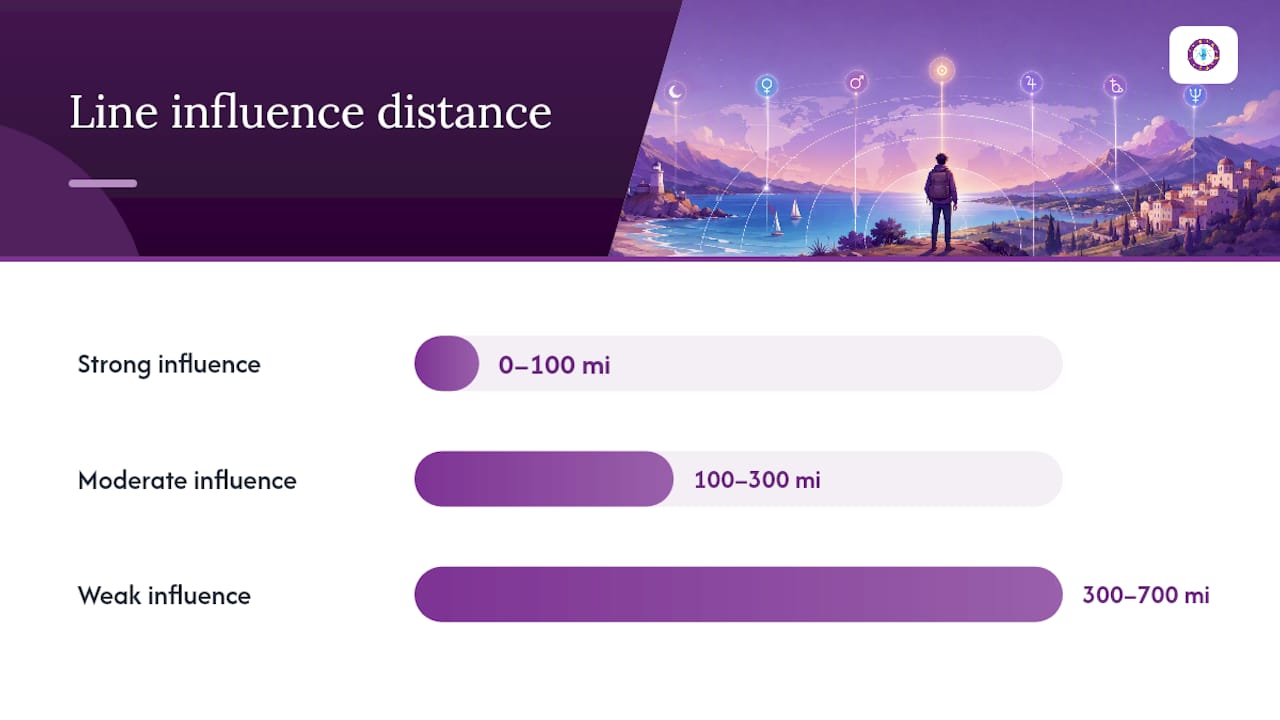
Rough bands practitioners use:
- Strong influence: within about 0 to 100 miles of the exact line
- Moderate influence: up to roughly 300 miles
- Weak influence: beyond 300 miles, tapering out somewhere between 300 and 700 miles depending on the reader
These aren’t hard walls. Practices vary, and some readers extend the outer edge to nearly 700 miles for slower-moving planets like Saturn or Pluto.
Power spots, where two or more lines cross, intensify whatever those planets represent, for better or worse. A Venus/Jupiter crossing near a coastal city might explain why that place keeps calling you. Paran lines work differently. They’re horizontal bands formed where two planets rise, set, or culminate at the same moment for your birth, and they matter most when you’re scanning an entire latitude rather than one pinpoint city.
How to Read Your Astrocartography Map, One Place at a Time
Reading an entire world map at once is overwhelming and not particularly useful. A place-first method works better because it starts with a decision you’re actually facing.
- Pick a real place you’re genuinely considering, not a random dot on the map.
- Find the nearest line or lines to that city using your calculator’s distance readout.
- Identify the planet and angle on that line and write down what they mean together.
- Check the distance band. A line 40 miles away deserves more weight than one 400 miles off.
- Note any crossings near that spot, since a power spot changes the intensity of the read.
- Compare the result against your actual goal. A gorgeous Venus/DC line means little if you’re moving for a job, not a partner.
Add practical filters afterward: cost of living, visa rules, language, and climate all matter regardless of what your chart says.
Pro Tip: Before committing to a big move, book a short trip first. A line can look perfect on paper and still feel wrong in person, and a week on the ground tells you things no chart can.
Advanced Layers: Parans, Relocated Charts, and Realistic Cautions
Serious astrocartography analysis goes beyond static lines. A relocated chart rebuilds your entire birth chart as though you were born in the new location, which reveals house shifts that a plain line map doesn’t show. Transit timing adds another layer: a line that felt neutral for years can activate sharply when a slow-moving planet like Saturn or Pluto transits it.
Birth-time uncertainty deserves real caution here. Angle-based lines (AC, DC, MC, IC) are the most sensitive to timing errors, so a birth time that’s off by even 20 minutes can shuffle your entire distance ranking for a city.
Treat every reading as one input, not a verdict.
- Never use a single line as the sole basis for relocating, quitting a job, or ending a relationship
- Weigh map evidence against real-world factors like cost, family, and career stage
- Retest your birth data if a location’s read feels inconsistent with your lived experience
Interpretation should be paired with natal-chart and practical context rather than treated as a standalone answer, since the underlying calculations are precise but the meaning behind them is subjective by design.
If you want a second set of eyes on parans, relocated charts, or a birth-time correction, a live phone astrology consultation can walk through those layers with you in real time.
Using Astrocartography in Real Consultations
In practice, astrocartography works best as one input alongside natal and transit analysis, not a replacement for either. Effects from a relocation or a major line activation tend to unfold over three to six months, with deeper shifts taking longer to settle. My honest advice: treat a strong line as an invitation to investigate, not an instruction to obey.
— Jason
How to Get a Personalized Astrocartography Reading by Phone
Self-guided map reading gets you far, but it has limits. A phone astrology session fills the gaps a calculator can’t: comparing two or three cities side by side, stress-testing a line ranking against an uncertain birth time, or weaving your astrocartography chart into your existing natal and transit picture. That’s the real value Phonepsychicreaders offers over a static report. You get a live conversation with a hand-vetted astrologer instead of a printout you have to interpret alone.

It works well alongside the six-step method above. Bring your shortlist of cities, your birth data, and your actual goal, whether that’s a career move, a relationship decision, or simply peace of mind before a big trip. The reader can help you weigh trade-offs your chart shows but can’t resolve on its own. If you’re facing a decision that genuinely matters, start with the astrologer services page, or head straight to available readings to connect with someone now.
Where to Verify the Technical Details
For map generation, Astro.com’s locational tool runs on Swiss Ephemeris data. For interpretation method, the layered reading approach from AstroCarto is a solid reference. For city scoring, Astrolium’s calculator offers comparative ratings worth cross-checking against your own read.
Sources
- Planetary lines & astrocartography — Kim Mott
- Astro
- Astrocartography map interpretation — AstroCarto
- How to read an astrocartography map — AstroCarto (how-to)
FAQ
Which astrocartography line should I live on?
There’s no single “best” line for everyone. The right one depends on your goal: an MC line for career ambitions, a DC line for relationships, or an IC line if stability and roots matter most right now.
How do I read my astrocartography lines?
Identify the planet and angle on the nearest line to your city of interest, check the distance, and interpret that combination against your specific goal rather than a generic list of meanings.
How do I find my astrocartography lines?
Enter your birth date, exact time, and birthplace into a calculator built on Swiss Ephemeris data, then use its city or distance search to locate lines near any place you’re considering.
How legit is astrocartography?
The astronomical calculations behind the lines are accurate and standard across the field, but the interpretation is subjective and shouldn’t replace practical research or, for major decisions, a conversation with an experienced astrologer.