
Are Psychics Real? What Science and Experience Show

There’s no scientific consensus that psychics possess paranormal powers, and mainstream researchers still find no reproducible proof of it. But a handful of tightly controlled studies report small, statistically unusual effects, and countless people walk away from readings feeling genuinely helped. “Real” ends up meaning two different things: verifiable supernatural ability, and meaningful, felt guidance. The rest of this piece treats both honestly.
Key Takeaways
- Studies reporting small effects in psi research often suffer from methodological flaws like small sample sizes, flexible data analysis, and lack of replication.
- Many perceived psychic hits result from cold reading, the Forer effect, confirmation bias, and selective memory, not paranormal ability.
- Psychics can provide emotional comfort and clarity similar to counseling, especially during times of grief or uncertainty, without requiring paranormal proof.
- Proper vetting involves checking platform transparency, asking for concrete questions, avoiding pressure tactics, and treating readings as one perspective, not a final verdict.
Table of Contents
- Is There Scientific Evidence That Psychics Are Real?
- What Do Parapsychology Experiments Actually Report?
- Why Do Psychic Readings Sometimes Feel Uncannily Accurate?
- Can a Reading Help You Even Without Paranormal Proof?
- How Do You Evaluate a Psychic Before You Book?
- So, Are Psychics Real?
- What I’ve Learned Covering This Topic Honestly
- A Vetted Way to Explore a Reading for Yourself
- Sources
Is There Scientific Evidence That Psychics Are Real?
Mainstream psychology and neuroscience have not found reliable, repeatable proof that psychic abilities exist. That’s the blunt summary, and it holds up across decades of review. Skeptical bodies and long-standing critical surveys have repeatedly concluded that parapsychological evidence doesn’t meet the standards required for broader scientific acceptance, largely because the same handful of problems keeps showing up study after study.
The methodological complaints are specific, not just dismissive hand-waving:
- Small sample sizes that make chance results look more dramatic than they are.
- Analytical flexibility, where researchers can slice data multiple ways until something looks significant.
- Lack of preregistration, meaning hypotheses sometimes get written after the results come in.
- Replication failures, where a promising result in one lab quietly disappears when another lab tries it.
A 2026 systematic review of neuroimaging studies tied to psi research found exactly this pattern: heterogeneous results across labs, recurring methodological weaknesses, and a conclusion that definitive neural correlates for extrasensory perception remain premature. The reviewers didn’t slam the door shut, though. They flagged specific design improvements, like larger samples and stricter preregistration, that could make future claims more credible.
Statistic Callout: Reviews of psi experiments consistently describe effects as small and inconsistent rather than absent, and replication across independent labs remains the field’s most persistent weak point, not the initial discovery of an effect.
That distinction matters for how you read the rest of this article. “No proof of dramatic powers” and “zero interesting data” are not the same claim, and mainstream science is careful to make that separation even while remaining skeptical overall.
What Do Parapsychology Experiments Actually Report?
Believers don’t point to nothing. They point to specific, named studies, and understanding what those studies actually found (and where they fall short) helps you weigh psychic phenomena more honestly than either blind faith or reflexive dismissal.
The Stanford Research Institute ran a government-funded remote viewing program during the Cold War, and some of its internal analysts judged certain trial results as statistically significant, enough to sustain government interest for years. Critics note the program’s evaluation methods were loose by modern standards, but it remains the most cited real-world example proponents raise.
Ganzfeld telepathy experiments, run in sensory-deprivation conditions since the 1970s, have produced meta-analyses reporting small positive effects across pooled trials. Independent replication attempts have been mixed, which is exactly the kind of inconsistency mainstream reviewers flag as a concern rather than a resolution.
The most rigorous recent example is a triple-blind mediumship study, where neither the medium, the sitter, nor the researcher scoring the results knew which reading matched which person. That design reduces bias in ways older studies didn’t. The result: mediums correctly identified more intended readings than chance would predict, and the correct readings contained noticeably more accurate information than mismatched control readings.
Here’s the honest read on that number. Sixty-five point eight percent beats a coin flip, and the triple-blind design is genuinely stronger than most parapsychology research. But it’s a long way from the dramatic, consistent accuracy popular culture imagines from a “gifted” psychic. Effect-size language in this field describes small, statistical tilts detectable only across many trials, not single-session certainty you could bet your life savings on.
Why Do Psychic Readings Sometimes Feel Uncannily Accurate?
Most apparent psychic hits have a name, and it’s not clairvoyance. Cold reading is a set of techniques anyone can learn, and understanding them changes how you listen to a reading forever.
- Cold reading relies on high-probability statements (“You’ve been thinking about a change, maybe at work”) combined with careful observation of your reactions. A skilled reader watches your face, your posture, even your clothing and speech patterns, then refines vague guesses into apparently specific hits based on your feedback.
- Hot reading goes a step further: the reader has researched you beforehand, using social media, public records, or information gathered before the session even starts.
- The Forer effect (sometimes called the Barnum effect) explains why generic personality statements feel personally tailored. Most people rate vague, flattering descriptions as remarkably accurate about themselves.
- Confirmation bias and selective memory do the rest of the work after the session ends. You remember the three things that felt true and quietly forget the seven that didn’t.
Psychologists who study these mechanisms argue that cold reading, the Forer effect, and confirmation bias together explain a large share of perceived psychic accuracy, no paranormal ability required.
Pro Tip: Test a reader with one specific, verifiable detail that couldn’t be guessed from your appearance, tone, or general life stage, like a specific name or a recent, unusual event. A gifted reader may surprise you. A cold reader will pivot to vague generalities instead of engaging directly with your test.

Can a Reading Help You Even Without Paranormal Proof?
People usually reach for a psychic reading during grief, a major crossroads, or plain uncertainty about a relationship or career move. In those moments, what actually helps often looks less like prophecy and more like structured, empathetic listening.
- A good reading functions similarly to a short, focused counseling session, someone giving your scattered thoughts a shape and a narrative.
- The value shows up in decision clarity and emotional relief, benefits that even skeptical psychology sources acknowledge as real regardless of whether any paranormal claim holds up.
- Practitioner reviews note that outcomes depend heavily on the client’s readiness and the reader’s interpersonal skill and timing, not just what’s said.
That’s a meaningful distinction: subjective value and objective, verifiable accuracy are two separate questions. A reading can genuinely help you process a loss, as many people describe when seeking closure after a death, without that comfort proving the reader saw your future.
How Do You Evaluate a Psychic Before You Book?
Protecting yourself starts before the call connects, not during it. Run through this sequence and you’ll filter out most bad actors quickly.
- Check the vetting process. Ask how readers are screened and whether the platform publishes pricing, refund terms, and per-minute rates clearly before you pay.
- Ask about recording. A reader confident in their work usually has no objection to you taking notes or recording for your own reference.
- Test specifics, not generalities. During the session, ask a direct question that requires a concrete, checkable detail rather than an open-ended prompt they can steer.
- Watch for pressure tactics. Real guidance doesn’t require you to book another session immediately or spend more to “remove a block” they just introduced.
- Sit with it afterward. Give yourself a day before acting on anything financially significant, and treat major life decisions as decisions requiring more than one input.
Pro Tip: Never let a single reading be the deciding vote on a major financial or relationship decision. Treat it as one perspective among several, the way you’d treat a good friend’s opinion rather than a verdict.
If you want a practical model for how vetting should work, look at how honest, no-fluff guidance services describe their screening before you commit to a paid session anywhere.
So, Are Psychics Real?
The honest answer stays nuanced. Mainstream science hasn’t validated psychic powers, but a few rigorous, blinded studies report small effects too consistent to wave away entirely. Use readings for reflection, emotional support, or a fresh angle on a decision you’re already wrestling with, never as your only input on something that carries real financial or legal weight. Run any reader through the evaluation checklist above before you pay for anything.
What I’ve Learned Covering This Topic Honestly
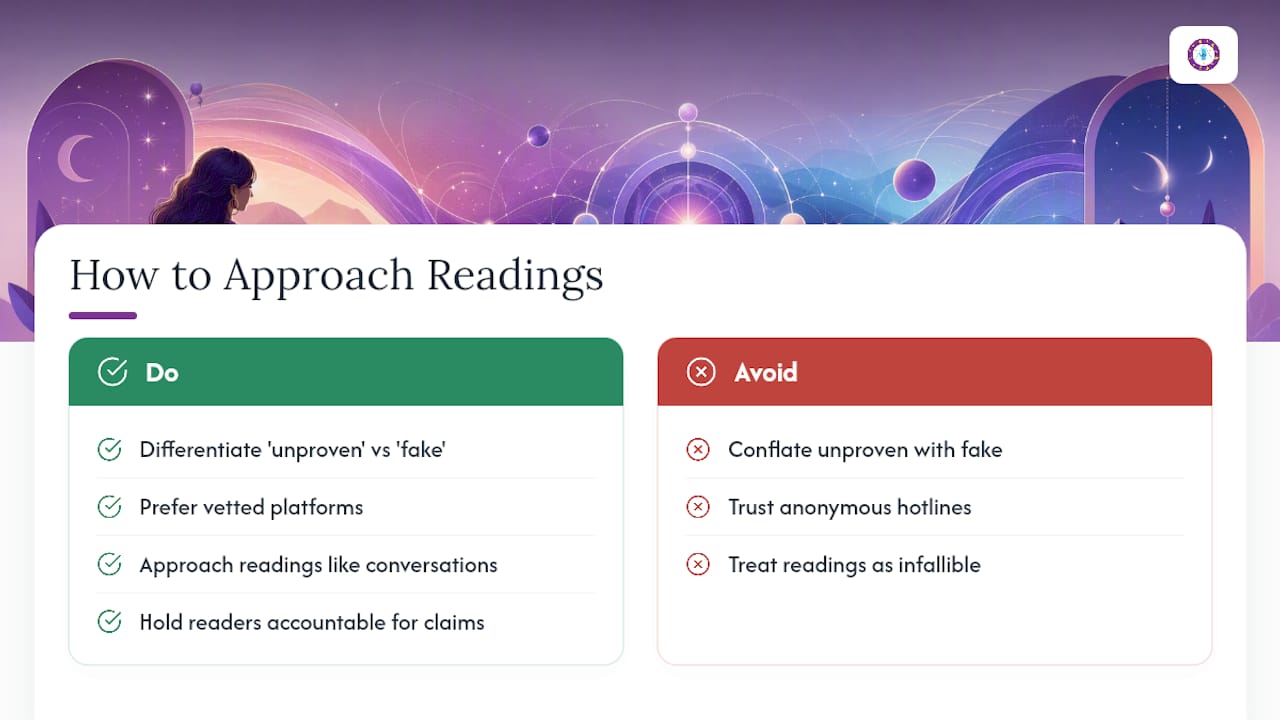
The biggest mistake I see in coverage of this topic is treating “science hasn’t proven it” as the same thing as “it’s obviously fake.” Those are different claims, and collapsing them does a disservice to both skeptics and believers. The triple-blind mediumship data is real, peer-reviewed, and better designed than most psi research that came before it.
What I respect more than any single study is vetting rigor. A platform that rejects most applicants and holds readers accountable for how they communicate is doing something structurally different from an anonymous hotline. If you’re curious, approach a reading the way you’d approach a good conversation with someone perceptive: useful, not infallible.
— Jason
A Vetted Way to Explore a Reading for Yourself
If you’ve read this far and you’re still curious, the honest next step is trying a reading with someone accountable rather than anonymous. Phonepsychicreaders accepts only a small percentage of applicants into its network, so you’re not gambling on a random hotline pickup. Sessions run 24/7 by phone, billed per minute, with first-time caller discounts that make testing the experience low-stakes.
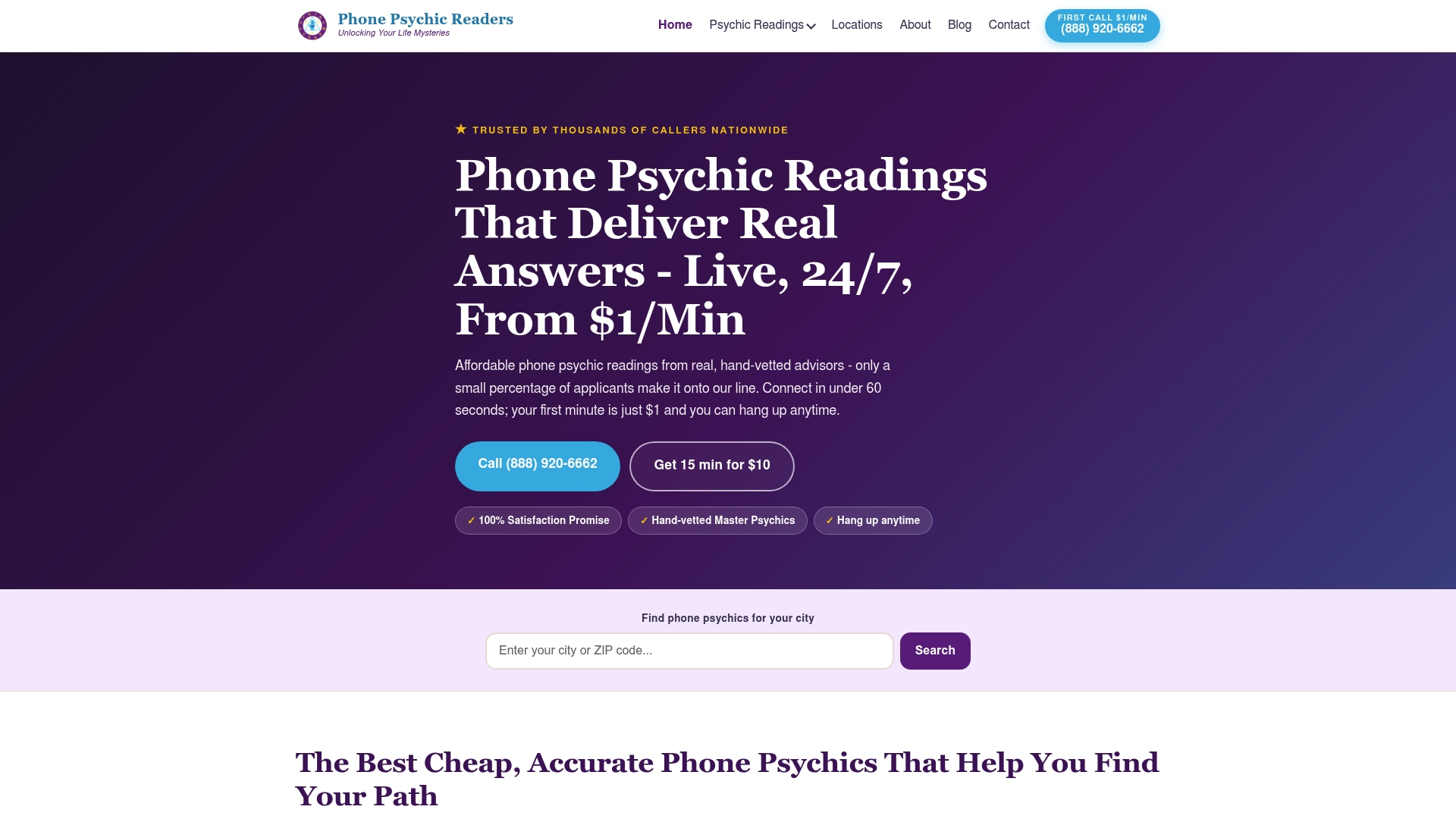
This kind of reading fits best when you want quick clarity on a specific question, emotional support during a hard stretch, or a second perspective before you decide something on your own. It’s not a replacement for financial or legal advice, and it’s not meant to be your only input on a major life decision. Browse the full range of session types on the readings page, or if you’re weighing something significant, see which service fits big life decisions before you book your first call.
Sources
- Original Research Mediumship accuracy: A quantitative and qualitative study with a triple-blind protocol
- Systematic review of neuroimaging and psi paradigms (Europe PMC)
- Should You Believe in Psychics? | Psychology Today